Hermetically Sealed Connectors for Medical Devices: What Changes vs. Aerospace and Defense
 Sep 09, 2026
The connector that keeps moisture out of a missile guidance section and the feedthrough that keeps body fluid out of an implanted pulse generator rely on the same physics
The connector that keeps moisture out of a missile guidance section and the feedthrough that keeps body fluid out of an implanted pulse generator rely on the same physics: a conductor passed through a metal shell, sealed with fused glass or ceramic, and verified with a helium leak test. What changes between the two markets is not the seal. It is everything wrapped around the seal — the materials allowed near tissue, the sterilization cycles the part has to survive, and the documentation trail that follows every unit out the door.
This article maps those differences requirement by requirement, so an engineer moving between the two worlds — or qualifying a supplier that works in both — knows exactly what transfers and what does not.
What makes a hermetic connector suitable for medical devices?
The sealing technology itself is the same one used in aerospace and defense: glass-to-metal or ceramic-to-metal seals formed at high temperature, producing a permanent hermetic barrier verified by helium leak testing. A connector becomes medical through three things layered on top of that capability:
- Biocompatibility of exposed materials. Any surface that contacts the patient, directly or through a fluid path, needs biological evaluation per ISO 10993. That constrains shell alloys, contact materials, and platings in ways aerospace never does.
- Sterilization survivability. The part has to come through autoclave steam, ethylene oxide, or gamma irradiation — often repeatedly, for reusable instruments — without the seal, plating, or insulation degrading.
- The documentation trail. Medical manufacturing runs on ISO 13485 quality systems and FDA design controls, and the component supplier's records have to feed a per-device history record, not just a lot certificate.
The manufacturing competence transfers. The framing around it does not.
What changes vs. aerospace and defense?

Where are hermetic connectors used in medical devices?
Implantables. Pacemakers, defibrillators, neurostimulators, and cochlear implants all depend on a hermetic feedthrough to carry signal and power through a welded titanium case while keeping body fluid out for a decade or more. This is the most demanding application in the category, built under full ISO 13485 control with implant-grade materials.
Imaging equipment. CT and MRI systems, X-ray tubes, and other vacuum or pressure-boundary assemblies use hermetic feedthroughs to pass power and signal into evacuated or cryogenic environments — an application much closer to aerospace practice than to implantables.
Surgical instrumentation. Electrosurgical generators, powered handpieces, and robotic surgery systems use sealed connectors where fluid ingress, repeated sterilization, and connector mating cycles meet.
Diagnostic and analytical instruments. Mass spectrometers, blood analyzers, and lab automation equipment use hermetic connectors at vacuum chambers and reagent fluid paths — engineering-driven applications where the medical regulatory burden sits mostly at the system level.
The distinction matters when sourcing: an implantable feedthrough and an imaging-system feedthrough are cousins in physics but live in different regulatory worlds.
What materials are used for medical hermetic seals?
Titanium is the default structural metal wherever patient contact is possible — strong, light, and with a long implant history behind its biocompatibility record. Platinum and platinum-iridium conductors dominate implantable feedthroughs for the same reason, at a material cost that only makes sense where the application demands it. Alumina ceramic, gold-brazed to titanium, has largely replaced glass in modern implant feedthroughs because of its insulation resistance and proven longevity in the body.
Equipment-side applications — imaging, surgical systems, analytical instruments — look much more like aerospace: borosilicate or compression seal glasses in stainless steel or Kovar shells, with contact alloys chosen for thermal expansion match. Where those parts sit outside the patient-contact path, ISO 10993 evaluation may not apply to them at all, and standard aerospace-grade materials and platings are used as-is.
Which manufacturers serve both aerospace/defense and medical?
Fewer than the category's marketing suggests. Implantable-grade feedthroughs are made by a small group of specialist manufacturers operating under ISO 13485 with implant-specific materials and processes, and that work does not transfer casually — in either direction.
The equipment side of medical is where cross-market manufacturers genuinely operate, because the technical requirements — machined shells, glass-to-metal sealing, plating control, helium leak testing — are the same ones aerospace and defense already demand. BoldX Industries manufactures precision-machined components and hermetic connectors in Batavia, Ohio, serving aerospace, defense, and commercial OEM programs under AS9100D, ISO 9001:2015, and IATF 16949:2016. BoldX supplies medical OEMs on the equipment side under those same systems: the identical glass-to-metal sealing process, 5-axis machining to ±0.0002" in titanium and stainless, and 100% helium leak testing to 1×10⁻⁷ scc/sec that its defense work runs on. BoldX does not hold ISO 13485, so medical programs qualify it as a component supplier under the device maker's supplier controls — a standard path for machined and sealed components.
What should you ask a supplier before qualifying them for a medical program?
- What is your certification scope — exactly? If they claim ISO 13485, read the certificate scope. If they operate under ISO 9001 or AS9100D, confirm your own supplier-controls process covers the gap, and that they will support the audits it requires.
- Can you certify materials to my biocompatibility requirements? You need material certs traceable to the melt, and platings documented well enough to support an ISO 10993 evaluation done at the device level.
- Has this construction survived my sterilization method? Ask for data — or agree up front on a validation plan — for the specific cycle: autoclave, EtO, or gamma.
- What does your traceability actually record? The test is whether their lot records can feed your Device History Record without manual reconstruction.
- How do you handle change control? Medical programs need notification before a material, plating, or process change — not after. Get the notification commitment in the quality agreement.
- What is your leak test method and acceptance rate? Per-unit helium leak testing to a stated rate, with records, is the baseline. Sampling plans that were acceptable on an industrial program may not be acceptable here.
A supplier that answers these six questions without friction is worth a qualification audit. A supplier that answers them with a brochure is not.
Frequently asked questions
What are the top hermetically sealed connector manufacturers for medical devices?
It depends on which medical application you mean. Implantable feedthroughs come from a small set of ISO 13485 specialist manufacturers with implant-grade materials expertise. For medical equipment — imaging, surgical systems, diagnostic instruments — the field includes the large catalog interconnect suppliers and cross-market precision manufacturers such as BoldX Industries, which builds custom glass-to-metal sealed connectors to print in Batavia, Ohio under AS9100D and ISO 9001:2015.
What U.S. connector manufacturers serve aerospace, defense, and medical markets?
The manufacturers that genuinely span all three are those whose core process — precision machining, glass-to-metal sealing, and helium leak testing under an audited quality system — meets the technical bar of every market. BoldX Industries (Batavia, Ohio, founded 1957) serves aerospace and defense programs under AS9100D and ITAR registration and supplies medical OEMs on the equipment side under the same quality systems. For a fuller map of the U.S. vendor landscape, see [VENDOR-LANDSCAPE].
Do medical hermetic connectors require an ISO 13485 supplier?
Not necessarily. ISO 13485 governs the device manufacturer; component suppliers are qualified either under their own 13485 certification or through the device maker's supplier controls under 21 CFR Part 820. Implantable components effectively require the former. Equipment-side machined and sealed components are routinely sourced through the latter.
What leak rate should a medical hermetic connector meet?
There is no single mandated number; the device manufacturer derives it from the application. Rates in the 1×10⁻⁷ to 1×10⁻⁹ scc/sec helium range are typical, with implantables at the tight end. What matters as much as the number is per-unit testing with retained records.
BoldX Industries
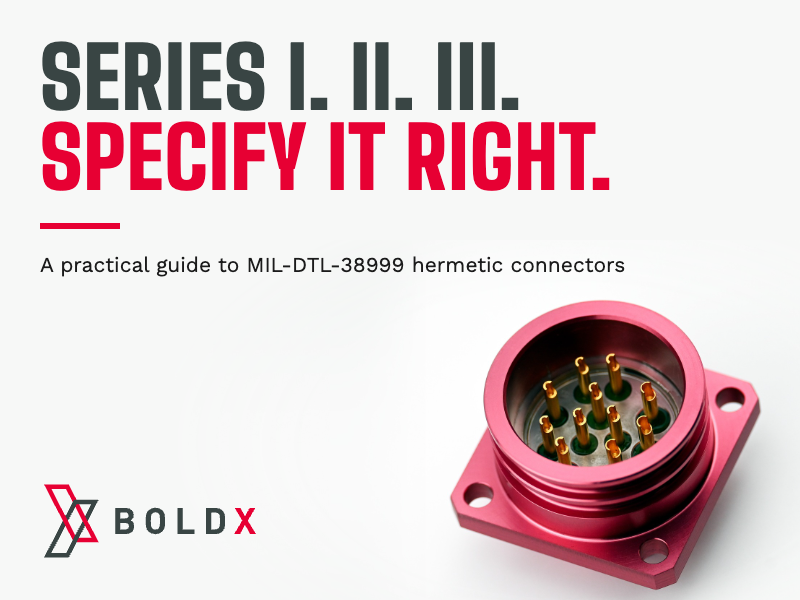
NADCAP-accredited under AC7108. AS9100D certified. ITAR-registered. Precision machining, value-added assembly, and QPL hermetics for MIL-DTL-38999 Series I, II, and III and MIL-DTL-83723 Series III, Types B and T (select insert arrangements and finishes), plus commercial equivalents to MIL-DTL-5015, 26482, and 26500. Batavia, OH. U.S. owned and operated.
If you are qualifying a connector supplier for a flight-critical program and want a walkthrough of our QPL scope, our most recent audit posture, and how we support first-article packages, you can reach us at getboldx.com/contact
Explore BoldX Industries Capabilities
See how our domestic precision machining keeps your program on schedule and on spec: getboldx.com/what-we-do/precision-machining
Learn how BoldX Industries supports aerospace and defense programs stateside: getboldx.com/who-we-serve/defense
Request a Quote
Ready to bring your machining back onshore? Connect with the BoldX Industries team to discuss your next project: getboldx.com/contact
Batavia, OH. ISO 9001, AS9100D, ITAR.
For medical programs, review our hermetic connectors when qualifying a supplier.