MIL-DTL-38999 Hermetic Connectors: A Procurement Guide for Flight-Critical Programs
 May 27, 2026
The MIL-DTL-38999 spec defines the most widely deployed circular connector family in modern aerospace and defense.
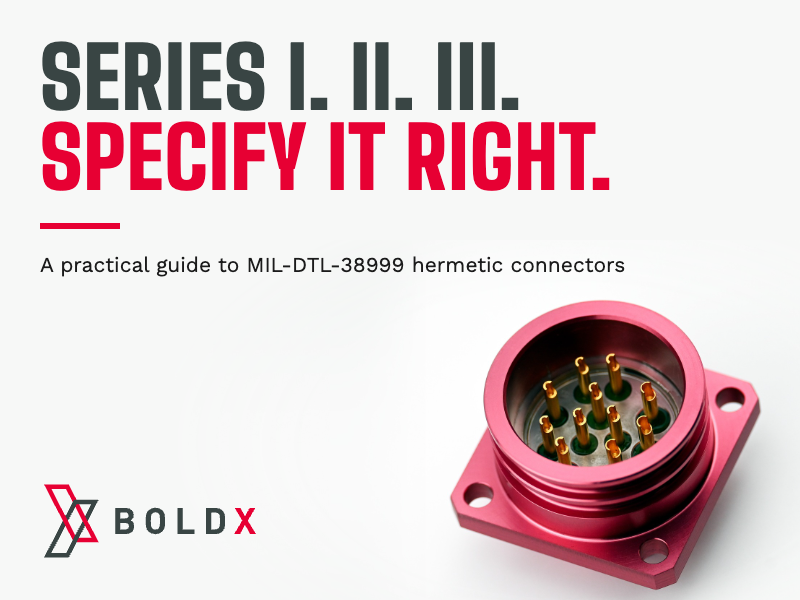
The MIL-DTL-38999 spec defines the most widely deployed circular connector family in modern aerospace and defense. If a system flies, fires, or interfaces with a vehicle's avionics, there is a high probability one of its harnesses terminates in a 38999 connector. The spec covers three production series, multiple coupling methods, and dozens of insert arrangements. Procurement teams qualifying a new supplier — or specifying a connector for a new program — face two questions: which series, and from whom.
This guide answers both.
The 38999 Family at a Glance
MIL-DTL-38999 governs miniature, scoop-proof, environment-resistant circular connectors. The spec was developed for military airborne applications and has since become standard across commercial aviation, missile systems, ground vehicles, satellites, and unmanned platforms.
Three series are in active production:
- Series I — bayonet coupling, scoop-proof, standard insert arrangements. Found on legacy airframes and ground equipment.
- Series II — low-silhouette bayonet coupling. Designed for weight- and space-constrained installations.
- Series III — triple-start threaded coupling, highest performance grade. The dominant choice for new aerospace programs.
All three series are environment-resistant: sealed against humidity, immersion, and altitude per MIL-STD-810. They share insert arrangements within the spec, so program teams can move between series without redesigning the cable side of the harness.
When Hermetic Matters
Standard 38999 connectors seal against environment. Hermetic 38999 connectors seal against pressure differential — the helium leak rate is specified, the seal is glass-to-metal rather than elastomeric, and the connector becomes part of a pressurized or vacuum-bounded enclosure.
Hermetic connectors are required when:
- Avionics bays are pressurized for high-altitude flight
- Cryogenic systems must hold vacuum (satellites, instrumentation)
- Hazardous-location equipment must contain ignition
- Fuel-system or hydraulic bulkheads cross pressure boundaries
- Test cells, vacuum chambers, and altitude simulators require sealed feed-throughs
Glass-to-metal seals do not age. Elastomers do. For a 30-year program life, hermetic terminations are the only seal architecture that survives unattended.
Three Questions Procurement Must Answer
A 38999 part number resolves to a specific connector through a series of letter and number codes. Three of those codes drive most of the cost, lead time, and qualification effort.
Coupling method. Series I (bayonet) is the choice for vibration-prone installations where rapid mate-demate is operationally critical. Series III (threaded triple-start) is the default for everything else. Threaded coupling is more robust at higher cycle counts and higher temperatures, and is the standard specification for new programs.
Insert arrangement. The insert defines pin count, pin size, and pin layout. Standard arrangements range from a few high-power contacts to more than a hundred low-signal contacts. The arrangement is fixed by the harness design and is not negotiable late in the program. Verify the arrangement on the schematic before issuing the RFQ.
Shell plating. Olive drab cadmium, electroless nickel, stainless passivated, and zinc-cobalt are the four most-specified finishes. Cadmium is being phased out of new defense programs for environmental compliance. Electroless nickel is the most common replacement. Confirm the plating on the program QPL before committing to a finish.
The QPL Question
MIL-DTL-38999 is a Qualified Products List specification. A supplier cannot sell a 38999 part for flight-critical use unless their specific part number appears on the QPL maintained by the Defense Logistics Agency. QPL qualification requires destructive testing of representative parts at an independent laboratory and re-qualification on a defined cycle.
When evaluating a connector supplier, ask three questions before the RFQ:
- Is the exact part number on the current QPL — not the series, the part number?
- When was the most recent re-qualification, and what is the next due date?
- Is the supplier the original QPL holder, or are they distributing a third party's qualified product?
The third question matters because second-source distribution introduces lead-time and continuity risk that the QPL listing alone does not surface.
What a Domestic, ITAR-Registered Supplier Solves
A 38999 program on a long timeline accumulates three categories of risk:
- Compliance — ITAR registration, AS9100D, NADCAP accreditation for any plating, traceable lot control
- Continuity — domestic shop capacity, second-source independence, no offshore single point of failure
- Communication — application engineering at the spec level, not just order-entry sales
The reshoring conversation in aerospace has matured beyond tariffs. Program managers are now evaluating suppliers on their ability to ship through a multi-year contract without a geopolitical disruption breaking the schedule. A domestic 38999 source removes one variable from that calculus.
BoldX Industries — MIL-DTL-38999 Production Capability
BoldX manufactures QPL-qualified MIL-DTL-38999 hermetic connectors across all three production series:
- B Series — MIL-DTL-38999 Series I, scoop-proof, hermetic. Jam nut, solder, and box mount.
- C Series — MIL-DTL-38999 Series II, low-silhouette, hermetic. Jam nut, solder, and box mount.
- D Series — MIL-DTL-38999 Series III, triple-start threaded, hermetic. Solder, box, jam nut, and weld mount.
All series are produced in Batavia, Ohio. ISO 9001:2015. AS9100D. IATF 16949:2016. NADCAP-accredited chemical processing. ITAR registered.
The full BoldX connector catalog is available at BoldX Hermetics Catalog.
Before You Send the RFQ
Three actions reduce qualification risk:
- Confirm the part number on the current DLA QPL. If it is not listed, the supplier cannot fulfill a flight-critical order against the spec, regardless of what the datasheet claims.
- Request the most recent qualification test report and the next re-qualification due date.
- Walk the supplier's shop floor — virtually or in person — before placing the first order. A flight-critical connector supplier's process control is visible on the floor in fifteen minutes.
A connector is a small line item on a bill of materials. A connector failure is not.
BoldX Industries
NADCAP-accredited under AC7108. AS9100D certified. ITAR-registered. Precision machining, value-added assembly, and QPL hermetics for MIL-DTL-38999 Series I, II, and III and MIL-DTL-83723 Series III, Types B and T (select insert arrangements and finishes), plus commercial equivalents to MIL-DTL-5015, 26482, and 26500. Batavia, OH. U.S. owned and operated. getboldx.com
If you are qualifying a connector supplier for a flight-critical program and want a walkthrough of our QPL scope, our most recent audit posture, and how we support first-article packages, I'm reachable directly.
Explore BoldX Industries Capabilities
See how our domestic precision machining keeps your program on schedule and on spec: getboldx.com/what-we-do/precision-machining
Learn how BoldX Industries supports aerospace and defense programs stateside: getboldx.com/who-we-serve/defense
Request a Quote
Ready to bring your machining back onshore? Connect with the BoldX Industries team to discuss your next project: getboldx.com/contact
Batavia, OH. ISO 9001, AS9100D, ITAR.
For flight-critical programs, review our MIL-DTL-38999 hermetic connectors and connector manufacturing capabilities before qualifying a supplier.