What Makes a Connector Mil Spec: Understanding MIL DTL 38999 and Hermetic Sealing Standards
 Mar 18, 2026
What defines a true mil spec connector? A closer look at MIL DTL 38999, QPL standards, and hermetic sealing for mission critical systems.
In high reliability environments where failure is not an option, the term mil spec is often used but rarely understood in full. It is not a general indicator of quality. It is a formal designation tied to strict requirements defined, tested, and maintained under controlled conditions. Nowhere is this more critical than in connector systems, where performance directly impacts the integrity of entire platforms.
From aerospace and defense systems to advanced industrial applications, connectors must operate under extreme conditions including vibration, temperature variation, pressure changes, and long lifecycle demands. Standards such as MIL DTL 38999 and hermetic sealing technologies exist to ensure that these components perform consistently in environments where failure carries significant consequences.
This article explains what truly makes a connector mil spec, how the qualification process works, and why hermetic sealing plays a critical role in mission critical systems, and how BoldX Industries approaches these requirements.
What Does Mil Spec Actually Mean
Mil spec refers to components that meet detailed requirements established by the United States Department of Defense. These specifications define not only how a component should perform, but also how it is designed, manufactured, and tested.
For connectors, this includes material selection, mechanical performance, electrical integrity, environmental resistance, and validation processes. A connector cannot be considered mil spec simply because it resembles one or claims similar performance. It must meet the defined criteria and pass formal qualification procedures.
MIL DTL 38999 is one of the most widely recognized specifications for circular connectors designed for harsh environments. It provides a structured framework that ensures connectors perform reliably across a wide range of demanding applications.
Understanding MIL DTL 38999
MIL DTL 38999 defines a family of circular connectors engineered for high performance in extreme conditions. These connectors are commonly used in military aircraft, space systems, naval equipment, ground vehicles, and advanced industrial platforms.
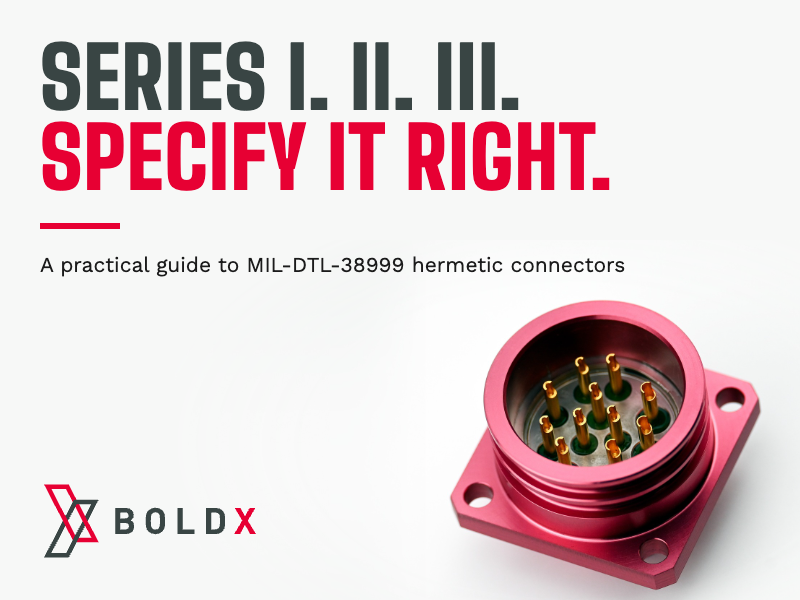
The specification includes multiple series, each designed for specific use cases. Series I uses a bayonet coupling system for quick connection. Series II offers improved environmental resistance in a lighter configuration. Series III features a threaded coupling system designed for high vibration environments and is one of the most widely used variants in aerospace and defense.
Across all series, the standard ensures high contact density within compact designs, strong resistance to vibration and shock, reliable performance across wide temperature ranges, and protection against environmental contaminants. These connectors are designed not only to function, but to maintain performance over time in conditions that would quickly degrade commercial alternatives.
What Are QPL Connectors
A critical part of mil spec qualification is inclusion on the Qualified Products List, often referred to as QPL. This is an official list of products that have been tested and approved to meet a specific military standard.
QPL status means that a connector design has undergone formal validation and that the manufacturer has demonstrated the ability to consistently produce that design to the required standard. This is not a one time approval. Manufacturers must maintain compliance through ongoing audits, process controls, and periodic testing.
Without QPL listing, a connector may be designed to resemble mil spec requirements, but it is not formally recognized as compliant. This distinction is essential in industries where traceability and verified performance are required.
The Qualification and Testing Process
Achieving mil spec status requires rigorous testing under controlled conditions. These tests are designed to simulate real world environments and ensure that connectors perform as expected over time.
Thermal cycling tests expose connectors to repeated transitions between extreme high and low temperatures to verify material stability. Vibration and shock testing simulate operational stresses encountered in aerospace and defense systems. Corrosion testing evaluates resistance to harsh environmental exposure such as salt and humidity.
Electrical testing confirms conductivity, insulation resistance, and signal integrity. Durability testing measures how well connectors perform after repeated mating cycles. Each test has clearly defined criteria, and failure in any category can disqualify a design.
This process ensures that connectors are not only capable of meeting performance requirements initially, but can sustain that performance throughout their operational life.
Why Hermetic Sealing Matters
Environmental sealing protects connectors from dust and moisture, but hermetic sealing provides a higher level of protection. A hermetic connector creates a gas tight barrier that prevents the passage of air, moisture, and other gases between environments.
This is critical in systems where pressure differences exist or where sensitive electronics must be protected from long term exposure to contaminants. In aerospace applications, connectors may be exposed to altitude driven pressure changes. In subsea environments, they must withstand external pressure while preventing internal leakage.
Hermetic sealing ensures long term stability and reliability in these conditions, making it essential for mission critical applications.
Glass to Metal Seal Technology
One of the most reliable methods for achieving hermetic sealing is glass to metal seal technology. In this design, conductive pins pass through a metal housing, and a specially formulated glass material is fused between the pins and the housing.
This creates a permanent bond that is both mechanically stable and airtight. The result is a connector that maintains a consistent seal over time, even under thermal expansion and mechanical stress.
Glass to metal seal connectors offer extremely low leak rates, strong resistance to temperature variation, and long operational lifespans. They are widely used in aerospace systems, defense electronics, oil and gas applications, and other environments where failure is not acceptable.
Hermetic Sealing Compared to Environmental Sealing
It is important to understand the difference between hermetic and environmental sealing. Environmental sealing typically relies on elastomers and gaskets to block external contaminants. While effective in many applications, these materials can degrade over time and are not fully airtight.
Hermetic sealing, by contrast, uses materials such as glass and metal to create a permanent barrier. This provides long term stability and prevents gas exchange between environments. For high reliability systems, hermetic sealing is often the preferred solution.
Where Standard Connectors Fall Short
Commercial connectors may be suitable for general applications, but they often lack the performance and reliability required for critical systems. They may not be tested under extreme conditions, and their materials and manufacturing processes may not support long term durability.
Inconsistent production quality, lack of traceability, and limited validation can introduce risk into systems where reliability is essential. In contrast, mil spec connectors provide a verified level of performance backed by standardized testing and controlled manufacturing processes.
The Role of Custom Connector Solutions
Even within established standards, many applications require customized connector solutions. This may involve specific pin configurations, unique materials, or specialized sealing requirements.
Customization allows connectors to be optimized for the exact conditions in which they will operate. This is particularly important in advanced systems where standard configurations may not fully address performance or integration requirements.
Working with a partner like BoldX Industries, who understands both mil spec standards and real world application demands, ensures that connector solutions are aligned with system level performance goals.
How BoldX Industries Approaches Mil Spec Connectors
At BoldX Industries, connectors are approached as part of a broader system strategy rather than as standalone components. The focus is on understanding the operating environment, performance requirements, and long term reliability expectations of each application.
This includes alignment with standards such as MIL DTL 38999, integration of hermetic sealing technologies where required, and implementation of rigorous validation processes. Whether working with QPL qualified components or developing custom solutions, the goal is to deliver consistent, predictable performance.
BoldX Industries supports customers across aerospace, defense, and advanced industrial sectors where precision and reliability are critical.
Reliability Comes Down to Execution
Mil spec connectors are defined by more than design. They are defined by adherence to strict standards, formal qualification processes, and proven performance in demanding environments. MIL DTL 38999 provides a framework for high performance connector systems, while hermetic sealing technologies ensure long term reliability in conditions where environmental exposure cannot be tolerated.
Understanding these factors is essential when selecting connectors for mission critical applications. The difference between a connector that meets requirements on paper and one that performs in the field can determine the success of an entire system.
Explore BoldX Industries Capabilities
Explore our connector solutions and capabilities:
https://www.getboldx.com/what-we-do/connectors
Learn how BoldX Industries supports defense and high reliability applications:
https://www.getboldx.com/who-we-serve/defense
Read more about hermetic connector performance:
https://www.getboldx.com/news/built-to-withstand-hermetic-connectors
If you are evaluating connector solutions for a high reliability application, connect with the BoldX Industries team to discuss your requirements or request a custom solution:
https://www.getboldx.com/contact
For mil-spec programs, reviMIL-DTL-38999 hermetic connectors when selecting a qualified supplier.