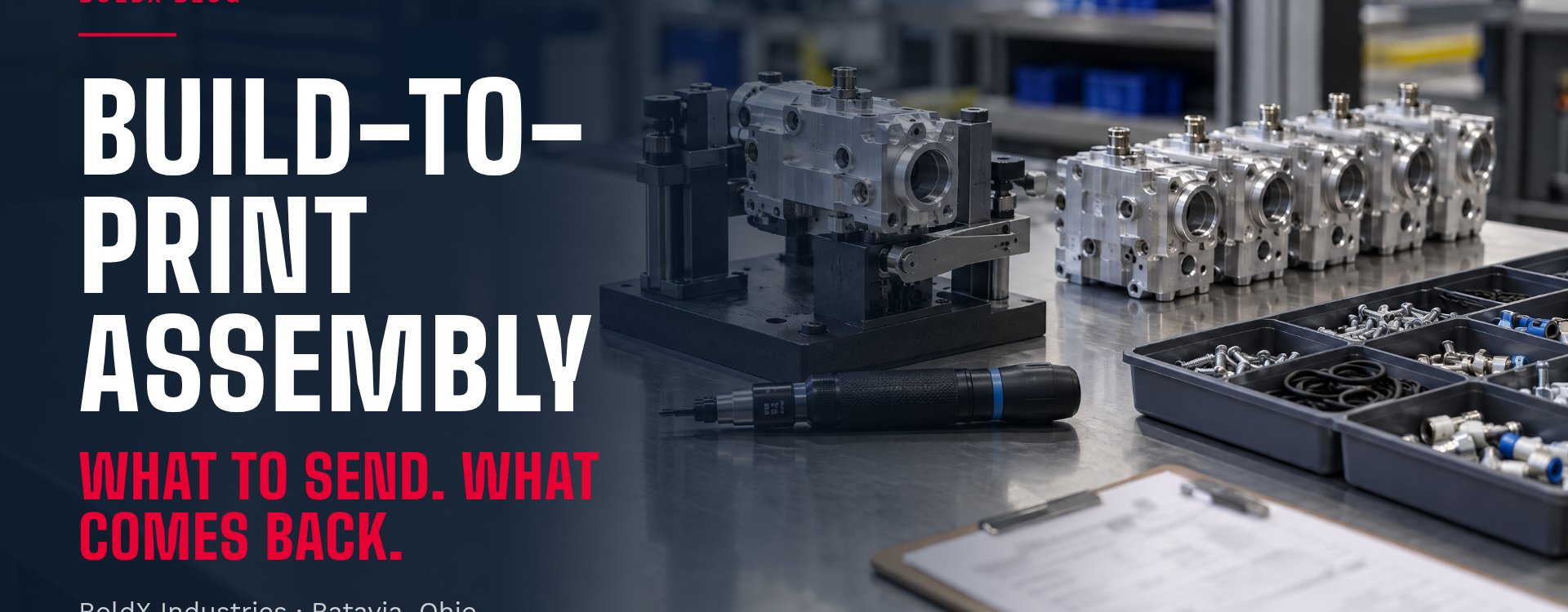
Build-to-Print Assembly for Defense Programs: What to Send, What to Expect Back
 Oct 28, 2026
What to send a build-to-print assembly supplier, what records to expect back, and where multi-supplier defense programs lose traceability.
Most defense assemblies pass through more hands than the drawing suggests. One shop machines the housing. Another applies the finish. A third supplies the connectors. A fourth builds the unit. Every handoff is a place where a schedule slips, a certification goes missing, or a substitution slides through without anyone noticing.
Build-to-print assembly exists to close those gaps. When it's set up well, the supplier builds exactly what your technical data package defines and returns objective evidence that it did. When it's set up poorly, the first article turns into a negotiation instead of a verification.
This guide covers what to send a build-to-print supplier, what you should expect back, where programs most often go wrong, and how to judge whether a supplier is ready for the work.
What Build-to-Print Actually Means
In a build-to-print arrangement, the customer owns the design. The supplier's job is to build to the released drawings and specifications without changing them, and to raise questions when the package is unclear rather than quietly filling the gaps.
That's different from build-to-spec or design-and-build work, where the supplier has latitude to make design decisions. In build-to-print, any deviation goes through your engineering, not around it. The supplier can and should offer manufacturability feedback, but the decision belongs to the design authority.
What to Send
A build-to-print supplier can only be as precise as the package it receives. Before the first part is cut, the supplier needs the following.
A released drawing package at the correct revision
Every detail drawing, the assembly drawing, and every referenced specification. Revision mismatches between the purchase order and the drawing are among the most common causes of first article rejection. Make sure the PO calls out the same revision the supplier has in hand.
A complete bill of materials with approved sources
If the program requires specific QPL parts or approved manufacturers, the BOM has to say so. "Or equivalent" invites substitutions your program may not accept. List the source requirements, not just the part numbers.
Process requirements in writing
Torque values, sealant and adhesive specifications, potting procedures, wire routing, cleanliness requirements, and any special processes such as plating or chemical conversion coating. Anything that lives only in a veteran technician's memory at the previous supplier has to be written down before the transfer.
Test requirements and acceptance criteria
Electrical continuity, insulation resistance, leak testing, functional test procedures, and the format you want results recorded in. If a test is required on every unit, say so. If sampling is allowed, define the plan.
Packaging, marking, and flowdowns
Serialization, part marking method, ESD protection, preservation and packaging, and every contract flowdown that applies: quality clauses, DFARS requirements, export-control status, and any rated-order requirements.
What to Expect Back
A build-to-print supplier's job isn't only to deliver the assembly. It's to deliver proof. At minimum, expect:
- First article inspection to AS9102, covering every characteristic on the assembly drawing and accounting for every detail part and special process
- A certificate of conformance with each shipment, referencing the correct part number and revision
- Material and special process certifications traceable to the lots used
- A serialized traveler showing each operation, who performed it, and the inspection sign-off
- Test data for every unit where testing is required, not just a sample
If a supplier can't produce these on request, the program doesn't have a qualified source. It has a vendor.
Where Programs Go Wrong
Undocumented tribal knowledge
A program moves to a new supplier and the first units fail. The drawing was never wrong; it was incomplete, and the previous supplier compensated without telling anyone. Treat every transfer as a chance to capture the undocumented steps. Ask the outgoing supplier for travelers and work instructions if the contract allows it.
Unapproved substitutions
A fastener, O-ring, or connector is swapped for an "equivalent" that isn't on the approved list. It fits, it works, and it fails source inspection. Approved-source requirements belong on the BOM, and the supplier's receiving process should check against them.
Traceability breaks between suppliers
Lot identity has to survive the trip from machinist to finisher to assembler. Every time material changes hands, the certification has to travel with it, and it often shows up late or not at all. The more suppliers involved, the more places the chain can break.
Revision drift
Engineering releases a new revision. Purchasing's PO still references the old one. The supplier builds to whichever arrived last. A simple revision check at order acknowledgment catches most of this.
Treating the first article as a formality
The FAI is the point where the supplier proves the process, not just the part. If the FAI package is thin, incomplete, or doesn't map to the drawing, push back before production starts. Fixing a process after a full lot has shipped costs far more.
How to Judge Whether a Supplier Is Ready
Before you award, ask a few direct questions:
- How do you review an incoming technical data package, and how do you document questions back to us?
- Which operations do you perform in house, and which go out to subcontractors?
- How do you keep certifications and lot identity attached to material through outside processing?
- What does your traveler look like, and can we see a sample with sensitive data removed?
- What quality system and registrations cover this work, and are they current?
The answers to the second and third questions matter most. Every outside operation is another handoff your program depends on.
Plan the Transfer Before the First Order
If you're moving an existing assembly, build a short transfer plan before the first PO. List every detail part and who makes it today, every special process and who performs it, and every test with its procedure and acceptance criteria. Mark which items the new supplier will do in house and which it will buy. Then agree on how questions about the package get asked and answered, and who on your side signs off. A one-page plan like this keeps the first article focused on verification instead of discovery.
The Single-Source Advantage
Every handoff in a multi-supplier program is a risk. Putting machining, special processing, connector supply, and assembly under one quality system removes many of them.
BoldX machines precision components, manufactures hermetic connectors (including QPL-qualified parts where listed), holds NADCAP accreditation for chemical processing, and performs value-added assembly, all in one facility in Batavia, Ohio. Our quality system is certified to AS9100D, ISO 9001:2015, and IATF 16949:2016, and we're ITAR registered for export-controlled work. Our assembly programs can include kitting, custom packaging and labeling, and serialized, traceable components, with fit and function testing documented to spec. The goal is one traveler from raw stock to final assembly, one set of records, and one point of accountability.
FAQ
What is build-to-print assembly?
Build-to-print assembly means the supplier builds an assembly exactly to the customer's released drawings and specifications, without changing the design, and provides objective evidence that it did.
What documentation should a build-to-print supplier provide?
At minimum: an AS9102 first article inspection, certificates of conformance, material and special process certifications traceable to lot, a serialized traveler, and test data for every unit where testing is required.
How is build-to-print different from build-to-spec?
In build-to-print, the customer owns the design and the supplier follows it. In build-to-spec, the supplier has latitude to make design decisions that meet a performance specification.
Why do defense programs consolidate assembly suppliers?
Each handoff between suppliers is a chance to lose traceability, miss a certification, or introduce an unapproved substitution. Fewer handoffs means fewer of those risks.
Starting a Build-to-Print Program
If you're transferring an assembly, consolidating suppliers, or starting a new program, send the drawing package for review. We'll flag gaps before they become first article findings. Contact BoldX at 800-479-2193 or through getboldx.com/who-we-are/contact. Learn more about our value-added assembly work.
BoldX Industries
NADCAP-accredited under AC7108. AS9100D certified. ITAR-registered. Precision machining, value-added assembly, and QPL-qualified circular hermetic connectors for MIL-DTL-5015, 38999, 83723, and 26482. Batavia, OH. U.S. owned and operated.
getboldx.com (http://getboldx.com/)
If you are qualifying a connector supplier for a flight-critical program and want a walkthrough of our QPL scope, our most recent audit posture, and how we support first-article packages, you can reach us at getboldx.com/contact
Explore BoldX Industries Capabilities
See how our domestic precision machining keeps your program on schedule and on spec: getboldx.com/what-we-do/precision-machining
Learn how BoldX Industries supports aerospace and defense programs stateside: getboldx.com/who-we-serve/defense
Request a Quote
Ready to bring your machining back onshore? Connect with the BoldX Industries team to discuss your next project: getboldx.com/contact
Batavia, OH. ISO 9001, AS9100D, ITAR.