Source Approval: How Aerospace Primes Actually Qualify a New Supplier
 Oct 14, 2026
A part can be fully qualified and still be unbuyable until the prime approves the supplier. Source approval is the gate that decides whether a new source makes a fiscal deadline.
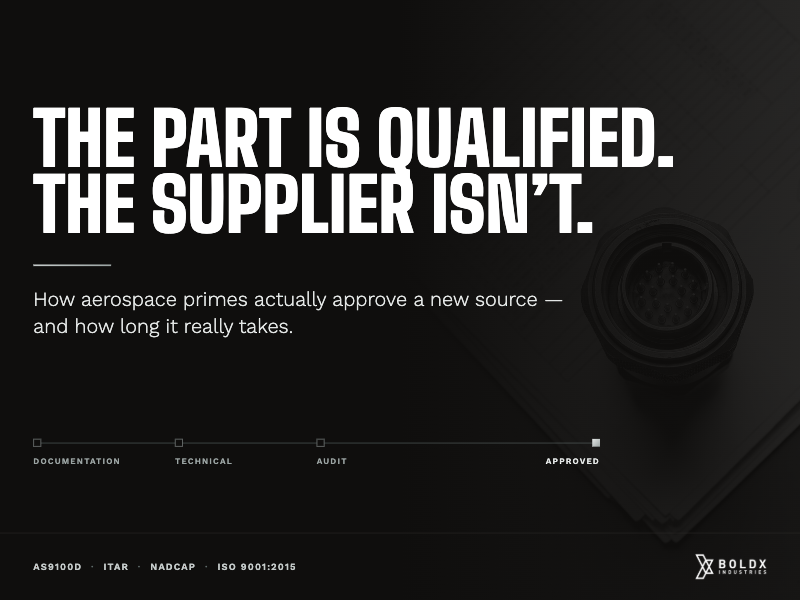
The part is qualified. The supplier isn't.
Those are two different problems, and program teams conflate them constantly. A connector can be QPL-listed, dimensionally perfect, and fully compliant with every callout on the drawing — and still be unbuyable, because the shop making it hasn't been approved as a source by the prime.
Part qualification proves the design meets spec. Supplier qualification proves the organization can produce it repeatably, document it correctly, and protect it appropriately. Primes treat these as separate gates because they fail in separate ways.
If you're trying to bring a new source online before a fiscal deadline, the second gate is what determines whether you make it.
What Source Approval Actually Is
Source approval is the process by which a prime contractor adds a supplier to its approved supplier list — the roster of vendors authorized to produce hardware for a given commodity or program.
The critical thing to understand is that engineering approval and procurement approval are not the same signature. An engineer can review your samples, agree the part is correct, and enthusiastically want to buy from you. That's necessary and insufficient. Supply chain, quality, and often program security each hold independent veto authority, and they evaluate against criteria engineering never touches.
This is why "the engineer loves us" so often fails to convert. The engineer wasn't the gate.
The Documentation Gate
This comes first, it's largely binary, and it stops more suppliers than the technical review does.
Quality management system. AS9100D registration is effectively mandatory for aerospace hardware. ISO 9001 alone rarely clears the bar. Expect the certificate, the scope statement, and recent audit findings to be requested.
ITAR registration. If the hardware falls under the U.S. Munitions List, registration with the Directorate of Defense Trade Controls is non-negotiable. An unregistered supplier is disqualified before technical evaluation begins. See ITAR CNC machining and the ITAR section of our certifications.
Special process accreditation. Any chemical processing, coating, heat treat, or NDT in the process flow needs NADCAP accreditation — in-house or through an accredited sub-tier. The audit criteria number matters; AC7108 covers chemical processing.
Cybersecurity posture. This has become a real gate rather than a formality. Expect questions on CMMC level, NIST SP 800-171 implementation status, and your SPRS score. Suppliers who treated this as a future problem are discovering it's a present one.
Financial and capacity review. Can you absorb the volume, and will you still exist in five years? Programs run long, and primes underwrite that risk at onboarding.
The Technical Gate
Once the paperwork clears, evaluation gets specific.
Capability survey. Equipment list, tolerance capability, inspection assets, materials experience — mapped against the actual part family, not generic claims.
Sample parts or a demonstration run. Real hardware, produced on the real process, inspected against the real drawing.
First Article Inspection to AS9102. The FAI package is where most technical rejections happen, and rarely because the part is wrong. It's because the documentation is incomplete — an unballooned drawing, a missing material cert, a characteristic without a recorded actual. A supplier who produces clean AS9102 packages routinely clears this in one pass. A supplier assembling one for the first time usually doesn't.
Process capability data. For key characteristics, evidence that the process holds — not that one part measured correctly, but that the process is centered and capable across a run.
A traceability demonstration. Increasingly common and genuinely revealing: an auditor pulls a finished part off the shelf and asks you to trace it back to the raw material certification, live. Shops with end-to-end traceability answer in minutes. Shops without it discover the gap in front of the customer.
The Audit
On-site or virtual, and it covers less exotic ground than suppliers expect.
Auditors look at calibration records — current, and traceable. They look at document control, checking whether the revision on the shop floor matches the revision in the system. They look at corrective action history, because how you handled past problems predicts how you'll handle theirs. They look at material segregation and FOD control. They look at training records.
The common failure points are mundane: undocumented process changes, a lapsed calibration on a gage still in use, corrective actions closed without verifying effectiveness. None of these are hard to fix. All of them are hard to fix quickly, which is why they cost schedule.
A Realistic Timeline
This is where planning usually breaks down.
For a straightforward commodity with a supplier who already holds every certification, source approval can move in a handful of weeks. For a supplier starting without AS9100D, or needing a NADCAP accreditation they don't hold, it can run the better part of a year — accreditation cycles alone have lead times measured in months.
The practical implication for anyone reading this with a near-term fiscal obligation: a supplier starting from zero will not make it. That isn't pessimism, it's arithmetic. The useful question isn't how to accelerate a cold start — it's which suppliers are already through the gates.
How to Compress It
You can't shortcut the process, but you can shorten it substantially by choosing a supplier who has already absorbed the delay.
Three questions on the first call:
- Which certifications do you hold today, and can I see the certificates and scope? AS9100D, ITAR, NADCAP with the audit criteria number.
- Do you carry QPL listings on the specs I need? An existing listing removes qualification testing from the critical path entirely — often the single largest schedule saving available to you. For hermetic connectors, BoldX is QPL-listed for MIL-DTL-38999 Series I, II, and III and MIL-DTL-83723 Series III, Types B and T (select insert arrangements and finishes); MIL-DTL-26500 is a commercial equivalent, not a QPL listing.
- Can you send a redacted AS9102 package you've already produced? This tells you in five minutes whether FAI documentation is routine or novel for them.
A supplier who answers all three imBoldX Industries
NADCAP-accredited under AC7108. AS9100D certified. ITAR-registered. Precision machining, value-added assembly, and QPL hermetics for MIL-DTL-38999 Series I, II, and III and MIL-DTL-83723 Series III, Types B and T (select insert arrangements and finishes), plus commercial equivalents to MIL-DTL-5015, 26482, and 26500. Batavia, OH. U.S. owned and operated.
If you are qualifying a connector supplier for a flight-critical program and want a walkthrough of our QPL scope, our most recent audit posture, and how we support first-article packages, you can reach us at getboldx.com/contact
Explore BoldX Industries Capabilities
See how our domestic precision machining keeps your program on schedule and on spec: getboldx.com/what-we-do/precision-machining
Learn how BoldX Industries supports aerospace and defense programs stateside: getboldx.com/who-we-serve/defense
Request a Quote
Ready to bring your machining back onshore? Connect with the BoldX Industries team to discuss your next project: getboldx.com/contact
Batavia, OH. ISO 9001, AS9100D, ITAR.mediately has done this before. That's the signal you're buying.
The Point
Source approval isn't bureaucracy for its own sake. It exists because a prime is underwriting your supplier's failure modes on their program, and they'd rather find the problems during onboarding than during a build.
But it has a clock, and the clock doesn't care about your fiscal year.
If you're evaluating sources for Q4 award, the suppliers worth calling are the ones already qualified — not the ones who could be.
BoldX Industries
NADCAP-accredited under AC7108. AS9100D certified. ITAR-registered. Precision machining, value-added assembly, and QPL hermetics for MIL-DTL-38999 Series I, II, and III and MIL-DTL-83723 Series III, Types B and T (select insert arrangements and finishes), plus commercial equivalents to MIL-DTL-5015, 26482, and 26500. Batavia, OH. U.S. owned and operated.
If you are qualifying a connector supplier for a flight-critical program and want a walkthrough of our QPL scope, our most recent audit posture, and how we support first-article packages, you can reach us at getboldx.com/contact
Explore BoldX Industries Capabilities
See how our domestic precision machining keeps your program on schedule and on spec: getboldx.com/what-we-do/precision-machining
Learn how BoldX Industries supports aerospace and defense programs stateside: getboldx.com/who-we-serve/defense
Request a Quote
Ready to bring your machining back onshore? Connect with the BoldX Industries team to discuss your next project: getboldx.com/contact
Batavia, OH. ISO 9001, AS9100D, ITAR.