Swiss Turning vs. Conventional CNC Turning: How to Tell Which Process Your Part Needs
 Oct 21, 2026
Five questions that decide whether your part belongs on a Swiss-type lathe or a conventional CNC lathe, and what to send with your RFQ.
Two shops can quote the same turned part and come back with prices that look like they belong to different drawings. Often the gap isn't margin. One shop planned the part on a Swiss-type lathe and the other planned it on a conventional CNC lathe, and for that geometry and quantity, one of those processes was the wrong call.
If you're an engineer releasing a turned part or a buyer comparing quotes, it helps to know which process the part actually wants. This guide covers how each machine works, the five questions that usually settle it, and what to send with an RFQ so the supplier can make the call with you instead of guessing.
How the Two Processes Actually Differ
Conventional CNC turning
On a conventional CNC lathe, the workpiece is held in a chuck or collet and spins while the tool moves along it. The part sticks out of the workholding, and the farther it sticks out, the more it can deflect under cutting load. Shops manage that with tailstocks, steady rests, lighter cuts, or extra setups.
Conventional lathes are built for a wide range of sizes. They handle larger diameters, short and stocky parts, and blanks that aren't bar stock, such as castings, forgings, and saw-cut slugs. Setup is usually faster, so they make sense for prototypes and short runs.
Swiss-type turning
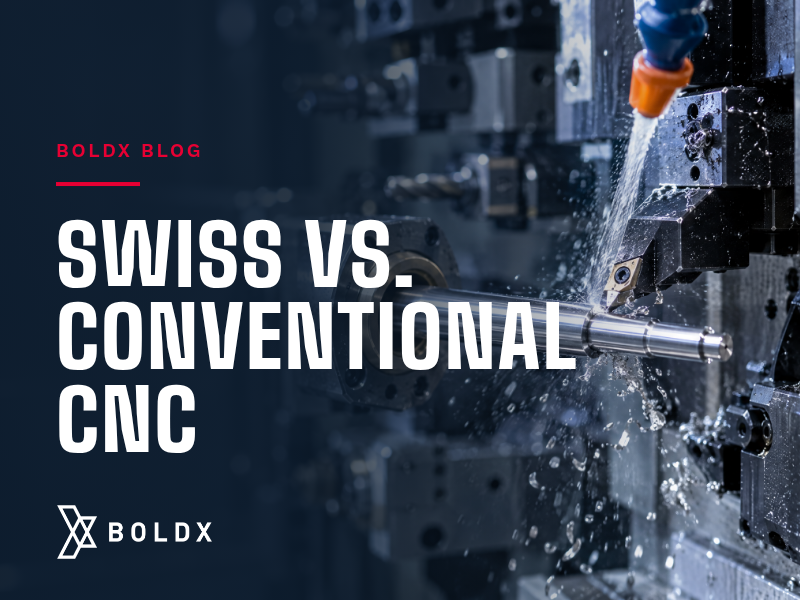
A Swiss-type lathe (also called a sliding-headstock lathe) feeds bar stock through a guide bushing. The headstock moves the bar along its axis while the tools cut right next to the bushing. Because the cut always happens close to the support point, a long, slender part doesn't hang out unsupported the way it would in a chuck.
Most modern Swiss machines also carry live tooling and a sub-spindle. That means cross holes, flats, slots, threads, and back-side features can be finished in the same cycle, and the part comes off the machine complete instead of moving to a mill for second operations.
Five Questions That Usually Decide It
1. How big is the part in diameter?
Swiss lathes are built around small bar stock. Their bar capacity is small compared with what a conventional lathe chuck can hold, so larger-diameter parts belong on a conventional lathe by default. If your part sits near the top of a Swiss machine's range, ask the supplier to confirm the machine it will run on before you assume Swiss pricing.
2. What is the length-to-diameter ratio?
This is the biggest single factor. Long, slender parts deflect on a conventional lathe, which costs you roundness, straightness, and diameter control, or costs the shop extra time to prevent those problems. A common rule of thumb is that once length gets past roughly three to four times the diameter, Swiss turning starts to earn its keep. Pins, shafts, probes, and contact-style parts are the classic cases.
3. How many features does the part have beyond the turned profile?
A plain turned diameter with a chamfer doesn't need a Swiss machine. A part with cross holes, flats, slots, off-axis features, and threads on both ends is a different story. If a conventional lathe would hand that part off to a mill for one or two more setups, Swiss turning with live tooling may finish it in one cycle. Fewer setups means less handling and fewer places for feature-to-feature relationships to drift.
4. What quantity, and how often?
Swiss setups take more time to prove out, and the process is built for repeat production. For a handful of prototypes, a conventional lathe is often quicker and cheaper to get started. Once quantities climb, or the part repeats on a schedule, the Swiss machine's cycle time and ability to run off bar stock with little operator involvement usually win.
Be honest about annual demand on the RFQ. A supplier planning for 50 pieces and a supplier planning for 50,000 pieces should not plan the part the same way.
5. Which tolerances actually matter?
Swiss turning is good at holding concentricity and runout between features, because so many features are cut in one setup on one support point. If your drawing's critical relationships are concentricity, runout, or position of cross features relative to the turned diameter, that points toward Swiss. If the critical dimensions sit on a large face or a short, rigid diameter, a conventional lathe can hold them without trouble.
Where Each Process Gives Something Up
Neither process is free. Swiss turning has trade-offs buyers should know about:
- Material form. Swiss machines run bar stock, and many setups want precision-ground bar for a consistent fit in the guide bushing. That can raise material cost.
- Bar remnant. Every bar leaves a remnant that can't be used. On expensive alloys like titanium or nickel alloys, that scrap shows up in the price.
- Setup time. A Swiss setup with several tools and a sub-spindle takes longer to prove out, which is why very low quantities often favor a conventional lathe.
Conventional turning gives up something too. On long, slender, feature-heavy parts it needs extra setups, steady rests, or secondary milling. Each added operation adds cost, lead time, and another chance to lose a feature relationship.
A Quick Decision Table
- Small diameter, long and slender: Swiss turning
- Many cross holes, flats, slots, or two-end features: Swiss turning with live tooling
- Repeat production at volume: Swiss turning
- Larger diameter, short and rigid: Conventional CNC turning
- Casting, forging, or non-bar blank: Conventional CNC turning
- Prototype or very short run: Often conventional; ask the supplier
Plenty of parts sit in the middle. A turn-mill or multi-axis lathe can be the right answer for a moderate-size part with milled features. Some parts are turned first and then go to a 4- or 5-axis mill. The table is a starting point for the conversation, not a substitute for it.
What to Send With a Turning RFQ
You'll get a better process recommendation and fewer quote revisions if the package includes:
- A drawing at the current revision and a 3D model
- Material and finish requirements, including any plating or heat treat
- Prototype quantity and expected annual demand
- Which characteristics are critical and how you expect them to be inspected
- Quality and export-control flowdowns such as AS9100D requirements, FAI, material certs, or ITAR
With that information, a supplier can tell you whether the part belongs on a Swiss machine, a conventional lathe, or a combination, and why.
Swiss Turning at BoldX in Batavia, Ohio
BoldX has been machining precision parts in Batavia, Ohio since 1957, when the company started as American Micro Products. Our Swiss turning work covers small, complex parts with live tooling, in aluminum, stainless steel, titanium, nickel alloys, and engineering plastics. We also run conventional CNC turning, multi-spindle work, grinding, EDM, and 4- and 5-axis milling under the same roof, so the process recommendation comes from what the part needs, not from which machine happens to be open.
Work runs under an AS9100D quality system, with first article inspection and lot-level traceability available, and ITAR-registered handling for export-controlled programs.
FAQ
When should a part be Swiss turned instead of turned on a conventional CNC lathe?
When it's small in diameter, long relative to that diameter, and carries several features such as cross holes, flats, or threads, especially at production volumes. Large, short, rigid parts and very low quantities usually fit a conventional lathe better.
Is Swiss machining more expensive than conventional CNC turning?
Per part, Swiss turning is often cheaper at volume because it finishes complex parts in one cycle. At low quantities, the longer setup and bar-stock requirements can make it more expensive. The answer depends on geometry and quantity.
Can a Swiss-turned part also need milling?
Yes. Live tooling handles many milled features, but some parts still need a second operation on a CNC mill or a multi-axis machine. A good supplier will plan both together.
What should I include in an RFQ for Swiss machining services?
A current drawing and model, material, finish, quantities, critical characteristics, and any quality or export-control requirements.
Get a Process Recommendation With Your Quote
Not sure whether your part should be Swiss turned? Send the drawing, model, material, and expected volumes through getboldx.com/who-we-are/contact or call 800-479-2193. We'll review the geometry and tell you which process we'd use and why. See our Swiss capabilities at getboldx.com/what-we-do/swiss-machining.
BoldX Industries
NADCAP-accredited under AC7108. AS9100D certified. ITAR-registered. Precision machining, value-added assembly, and QPL-qualified circular hermetic connectors for MIL-DTL-5015, 38999, 83723, and 26482. Batavia, OH. U.S. owned and operated.
getboldx.com (http://getboldx.com/)
If you are qualifying a connector supplier for a flight-critical program and want a walkthrough of our QPL scope, our most recent audit posture, and how we support first-article packages, you can reach us at getboldx.com/contact
Explore BoldX Industries Capabilities
See how our domestic precision machining keeps your program on schedule and on spec: getboldx.com/what-we-do/precision-machining
Learn how BoldX Industries supports aerospace and defense programs stateside: getboldx.com/who-we-serve/defense
Request a Quote
Ready to bring your machining back onshore? Connect with the BoldX Industries team to discuss your next project: getboldx.com/contact
Batavia, OH. ISO 9001, AS9100D, ITAR.