Hermetic Connectors 101: What They Are, Where They Go, and Why QPL Qualification Matters
 Aug 05, 2026
Three words on a program spec stop procurement cold: "QPL required."
If you've sourced connectors for a defense or aerospace program, you've seen them. You may also have seen what happens when someone treats them as a formality — a connector that satisfies every dimensional and environmental callout on the drawing gets rejected at source approval, because the part number isn't on a list.
This post is for the engineers and supply chain managers who hit that requirement and need the working knowledge behind it. What a hermetic connector actually is. Where hermeticity is non-negotiable. What QPL qualification takes, and why the government maintains the list at all. And how to tell whether a supplier can genuinely deliver against the requirement, or is only quoting to it.
No pitch until the end.
What Is a Hermetic Connector?
A hermetic connector maintains a true gas-tight seal between its two sides. Not "water resistant." Not "environmentally sealed." Gas-tight — and measurable.
That distinction matters because hermeticity carries a number. It's verified by helium leak testing, and aerospace requirements typically land at 1×10⁻⁷ atm·cc/sec or tighter. A connector either passes that test or it doesn't.
What makes it possible is the seal construction. In a hermetic connector, the pins pass through a glass or ceramic seal fused directly to the metal shell — no elastomer, no epoxy, no organic material anywhere in the sealing path. Two common approaches: compression seals, where the shell's higher rate of thermal expansion squeezes the glass as the assembly cools, and matched seals, where the glass and metal expansion coefficients are matched and bond chemically.
Where you find them: aircraft avionics bays that pressure-cycle from sea level to 40,000 feet, satellite electronics enclosures operating in hard vacuum, weapons system housings, downhole energy tools, and implantable medical devices. Anywhere a pressure differential, a vacuum, or a contaminant would end the mission.
What Is QPL Qualification?
A Qualified Products List is exactly what the name says — a government-maintained list of specific part numbers, from specific manufacturers, tested and proven to meet a military specification.
The operative word is proven. QPL status is not a self-declaration, and it isn't a certificate a supplier buys. To get a part listed, a manufacturer submits it for qualification testing against the governing spec — MIL-DTL-38999, MIL-DTL-26482, MIL-DTL-5015, and others. That testing is destructive and exhaustive: thermal shock, vibration, salt spray, insulation resistance, dielectric withstanding voltage, durability cycling, and leak rate for hermetic variants.
The manufacturer's facility is audited. Process controls are reviewed. And qualification isn't permanent — listed suppliers submit periodic retention testing to stay on the list, and a change in materials or process can trigger requalification.
For most connector specs, the qualifying activity is DLA Land and Maritime. You'll also encounter QML — Qualified Manufacturers List — which qualifies a manufacturer's process rather than an individual part number.
That's why programs specify it. QPL shifts the verification burden off your desk and onto a testing regime that has already happened.
Hermetic vs. Standard Connectors: Key Differences
In a catalog the two look similar. They aren't.
Sealing method. Standard sealed connectors use elastomeric grommets and interfacial seals, or an epoxy potting compound. These block liquid water and dust effectively. They do not block gas, and epoxy remains permeable to moisture vapor over time. Hermetic connectors use glass-to-metal or ceramic-to-metal seals — inorganic, non-permeable, stable across the full temperature range.
Shell material. Hermetic shells are typically stainless steel, or titanium where weight is critical. Aluminum appears in some designs but constrains the seal approach. Standard connectors are more commonly plated aluminum.
Environmental ratings. Hermetic parts carry a specified leak rate. Standard connectors carry an IP rating or a MIL environmental class. These are not equivalent claims, and they are not interchangeable on a spec.
Temperature range and cycling. Glass seals hold across wider swings and survive far more thermal cycles before the seal path degrades. In cycling applications, epoxy is the failure point.
Cost and lead time. Hermetic parts cost more and take longer. The seal process is slower, and every unit is leak tested — per unit, not per lot.
Why QPL Qualification Matters for Your Program
Here is the practical risk.
If your program spec calls for a QPL part and you source a functionally equivalent non-QPL connector, you will probably clear drawing review. Where it fails is downstream: DLA source approval, prime supplier qualification, or a first article audit. The correction lands after tooling, after the build, and usually after the schedule has run out of slack.
Programs specify QPL for reasons that have nothing to do with bureaucracy. In flight-critical hardware, a connector failure isn't a warranty event — it's a mission loss, and sometimes worse. The list exists because someone determined that the cost of independent verification was lower than the cost of finding out in the field.
Traceability compounds it. Defense programs increasingly require that every part be traceable back to its raw material certification, with lot traceability maintained across the production run. A supplier without that documentation discipline cannot support the requirement even when the part itself is sound.
This is where AS9100D enters. AS9100D registration covers the quality management system — risk management, configuration control, material traceability — that makes consistent production against a qualification possible in the first place. QPL qualifies the part. AS9100D is the system underneath it.
BoldX Industries and Hermetic Connector Manufacturing
BoldX has been machining precision components since 1957, and manufactures circular and hermetic connectors out of our facility in Batavia, Ohio.
On the subject of this article specifically: our circular hermetic connectors are QPL-qualified to MIL-DTL-5015, MIL-DTL-38999, MIL-DTL-83723, and MIL-DTL-26482. That means the qualification testing described above has already been run against our parts, and the listing is a matter of public record you can verify rather than a claim you have to take on faith.
The supporting credentials: AS9100D certification for aerospace quality management, including risk management and material traceability. ITAR registration with the U.S. Department of State, DDTC — a precondition for defense program work. ISO 9001:2015 for quality management system discipline. NADCAP accreditation under AC7108 for chemical processing, covering the validated surface treatments these parts require.
On capability: we hold tolerances as tight as 2 microns — roughly ±0.00008″ — and micro-machine features down to .004″. CMM inspection runs at multiple stages of the process, not only at final. Every part ships traceable back to its raw material certification, with lot traceability maintained across the run.
Domestic manufacturing. U.S. owned and operated. Built in Ohio.
If you're qualifying a connector supplier for a flight-critical program and want a walkthrough of our QPL scope, our most recent audit posture, and how we support first-article packages, that conversation is a short one — reach us here.
Conclusion
If one thing carries out of this: hermetic and QPL are two separate requirements, and satisfying one does not satisfy the other. Hermeticity is a physical property of the seal, verified by leak rate. QPL is a qualification status, verified by testing and audit against a military specification. A program can require either, or both.
When you evaluate a supplier, ask three things: the specific spec and part number they're qualified to, the leak rate they test to, and the traceability documentation that ships with the part. Shops that do this work answer quickly. Shops that don't, don't.
Safety First. Compliance Always.
Sourcing hermetic or circular connectors for an aerospace or defense program? Send us your RFQ.
BoldX Industries
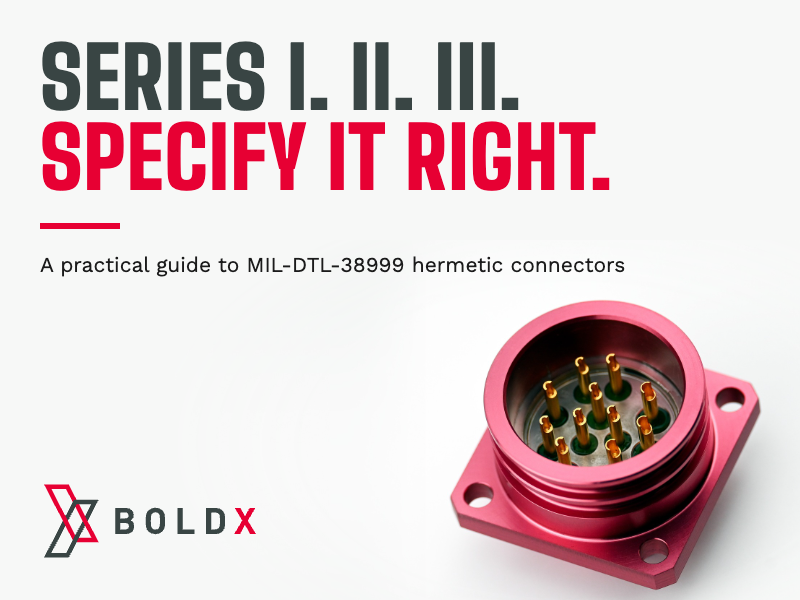
NADCAP-accredited under AC7108. AS9100D certified. ITAR-registered. Precision machining, value-added assembly, and QPL hermetics for MIL-DTL-38999 Series I, II, and III and MIL-DTL-83723 Series III, Types B and T (select insert arrangements and finishes), plus commercial equivalents to MIL-DTL-5015, 26482, and 26500. Batavia, OH. U.S. owned and operated.
If you are qualifying a connector supplier for a flight-critical program and want a walkthrough of our QPL scope, our most recent audit posture, and how we support first-article packages, you can reach us at getboldx.com/contact
Explore BoldX Industries Capabilities
See how our domestic precision machining keeps your program on schedule and on spec: getboldx.com/what-we-do/precision-machining
Learn how BoldX Industries supports aerospace and defense programs stateside: getboldx.com/who-we-serve/defense
Request a Quote
Ready to bring your machining back onshore? Connect with the BoldX Industries team to discuss your next project: getboldx.com/contact
Batavia, OH. ISO 9001, AS9100D, ITAR.
For qualified programs, review our hermetic connectors and MIL-DTL-38999 hermetic connectors when selecting a supplier.