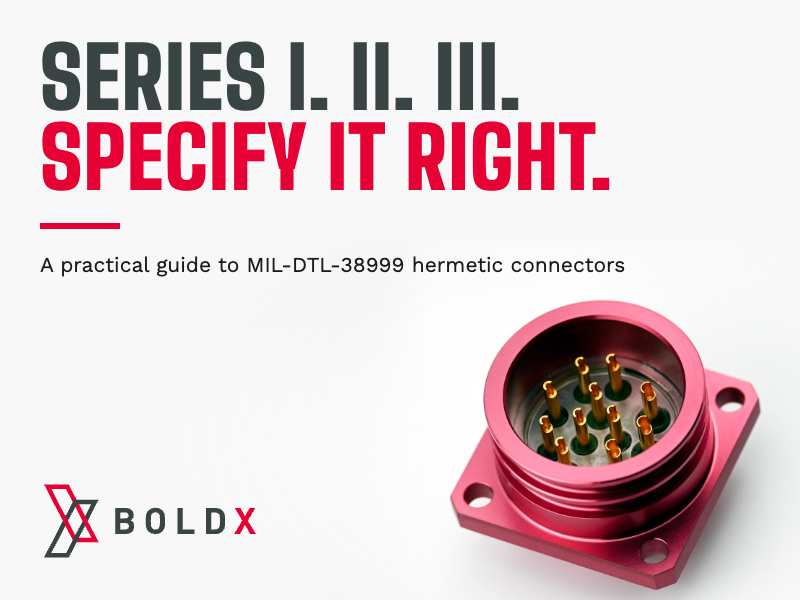
MIL-DTL-38999 Series I, II, or III: How to Specify the Right Hermetic Connector
 Oct 07, 2026
Series I, II, or III? A practical guide to specifying MIL-DTL-38999 hermetic connectors for aerospace and defense programs — coupling, mounting, and sealing.
A connector callout on a drawing looks simple. One part number. In practice, that part number encodes decisions about coupling, mounting, sealing, and qualification that determine whether the assembly survives its environment — and whether it clears source inspection.
MIL-DTL-38999 is the dominant circular connector specification in aerospace and defense. It is also one of the most frequently misspecified. This guide covers what separates Series I, II, and III, and what to confirm before you issue the PO for a hermetic version. For how 38999 compares to other circular families, see our four-spec chooser; for procurement framing, see the 38999 procurement guide.
Why Hermetic
Standard 38999 connectors seal against moisture and fluids. Hermetic connectors seal against gas. The contacts are fused into a glass insert that bonds to the metal shell, creating a barrier rated by helium leak rate rather than by ingress protection. (For how that seal is made, see what glass-to-metal sealing actually is.)
That matters wherever a pressure differential exists across the bulkhead: sealed avionics enclosures, fuel and hydraulic system sensors, vacuum and space-rated hardware, and any enclosure backfilled with inert gas. If the enclosure is designed to hold pressure, the connector must hold it too.
Series I: Scoop-Proof Bayonet
Series I uses a bayonet coupling and an extended shell that makes the connector scoop-proof — a mating plug cannot strike the contacts when it is inserted at an angle. That protection is the reason Series I is common in field-maintained equipment where connectors are mated blind or in tight access areas.
Specify Series I when: mating happens in the field, access is limited, and contact damage from misalignment is a real risk.
BoldX B Series — jam nut, solder, and box mount configurations.
Series II: Low Silhouette
Series II also uses a bayonet coupling but drops the extended shell. The result is a shorter, lighter connector that fits where space and weight are constrained. It is not scoop-proof, so it belongs in applications where mating is controlled.
Specify Series II when: envelope and weight drive the design and mating occurs in controlled conditions, such as at the factory or depot.
BoldX C Series — jam nut, solder, and box mount configurations.
Series III: Triple-Start Thread
Series III replaces the bayonet with a triple-start threaded coupling. It is scoop-proof, self-locking, and built for high-vibration environments. It mates quickly — the triple-start thread fully couples in a fraction of a turn compared to a standard thread — and resists decoupling under sustained vibration. Series III is the default choice for most new aerospace and defense designs.
Specify Series III when: the platform sees sustained vibration or shock, or the program needs the broadest current availability and support.
BoldX D Series — solder, box, jam nut, and weld mount configurations.
Mounting Style Is Not an Afterthought
The series defines the coupling. The mounting style defines how the connector interfaces with your enclosure — and for a hermetic part, the enclosure seal is only as good as the mount.
- Box mount: Flange with four fasteners and a gasket or O-ring. Serviceable and common.
- Jam nut: Single-hole mount through the panel. Compact, with a smaller panel cutout.
- Solder mount: The shell is soldered directly into the housing. A permanent, fully hermetic joint.
- Weld mount: The shell is welded into the housing. Used where the enclosure must hold hermeticity over the life of the system.
If the enclosure is designed to hold pressure long-term, solder and weld mounts eliminate the gasket as a leak path. If the unit must be serviced, box and jam nut mounts keep the connector replaceable.
Five Questions Before You Issue the PO
- Is the part QPL-qualified? Qualified Products List status means the design and the manufacturing source have been tested and approved against the specification. For defense programs, a non-QPL substitute can stop a delivery at source inspection.
- What leak rate does the drawing require? Confirm the helium leak rate on your drawing or slash sheet and confirm the supplier tests every unit to it — not a sample.
- What shell material and finish? Material and plating drive corrosion resistance, conductivity, and weight. Match them to the environment, not to the last program.
- What documentation ships with the part? Expect a certificate of conformance, material certifications, and inspection records traceable to the lot.
- Is the supplier's quality system aerospace-grade? AS9100D certification and ITAR registration are baseline requirements for defense work, not differentiators.
Where BoldX Fits
BoldX Industries manufactures glass-to-metal sealed circular hermetic connectors, QPL-qualified for MIL-DTL-38999 Series I, II, and III and MIL-DTL-83723 Series III, Types B and T (select insert arrangements and finishes), as well as commercial equivalents to MIL-DTL-5015, MIL-DTL-26482, and MIL-DTL-26500 (not QPL). Every connector is produced under an AS9100D quality system in our ITAR-registered Batavia, Ohio facility, with documentation that ships with the part. Spec hubs: 38999, 83723, 26500.
Because BoldX also provides precision machining and value-added assembly, programs can source the connector, the machined housing it seals into, and the assembled unit from one supplier — one quality system, one set of records, one point of accountability.
Need help specifying a hermetic connector for your program? Contact our engineering team at 800-479-2193 or visit getboldx.com/contact. The full catalog is available at getboldx.com.
BoldX Industries
NADCAP-accredited under AC7108. AS9100D certified. ITAR-registered. Precision machining, value-added assembly, and QPL hermetics for MIL-DTL-38999 Series I, II, and III and MIL-DTL-83723 Series III, Types B and T (select insert arrangements and finishes), plus commercial equivalents to MIL-DTL-5015, 26482, and 26500. Batavia, OH. U.S. owned and operated.
If you are qualifying a connector supplier for a flight-critical program and want a walkthrough of our QPL scope, our most recent audit posture, and how we support first-article packages, you can reach us at getboldx.com/contact
Explore BoldX Industries Capabilities
See how our domestic precision machining keeps your program on schedule and on spec: getboldx.com/what-we-do/precision-machining
Learn how BoldX Industries supports aerospace and defense programs stateside: getboldx.com/who-we-serve/defense
Request a Quote
Ready to bring your machining back onshore? Connect with the BoldX Industries team to discuss your next project: getboldx.com/contact
Batavia, OH. ISO 9001, AS9100D, ITAR.