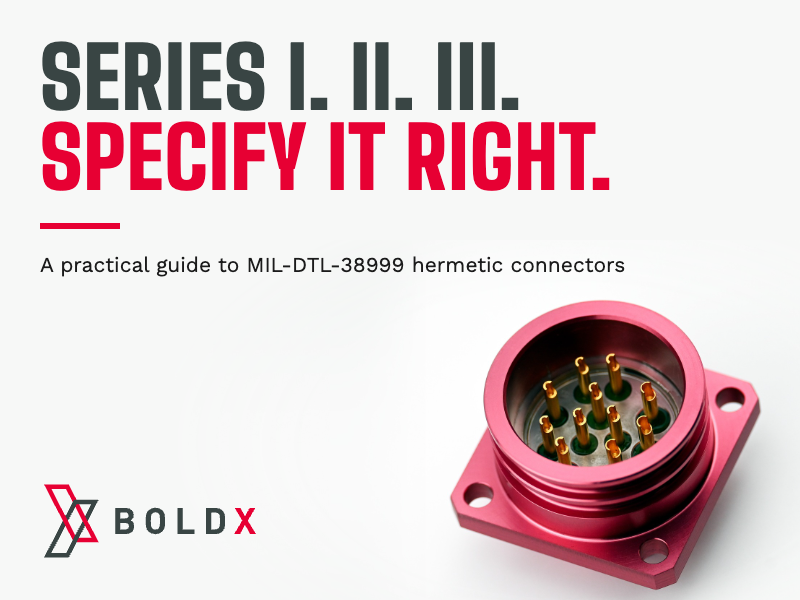
MIL-DTL-5015, 26482, 38999, or 83723? Choosing the Right Circular Connector Spec
 Aug 13, 2026
Somewhere in your drawing package, a connector is already specified. You didn't pick it, and the engineer who did retired years ago.
Somewhere in your drawing package, a connector is already specified. You didn't pick it, and the engineer who did retired years ago.
Or you're on the other side of it — clean-sheet design, and the callout is yours to make.
Either way, four specifications dominate circular connectors in aerospace and defense: MIL-DTL-5015, MIL-DTL-26482, MIL-DTL-38999, and MIL-DTL-83723. In a catalog they look like variations on a theme. They aren't interchangeable, and the differences that matter are mostly invisible on a datasheet until you understand what each one was designed to survive.
Here's what actually separates them.
The Four at a Glance
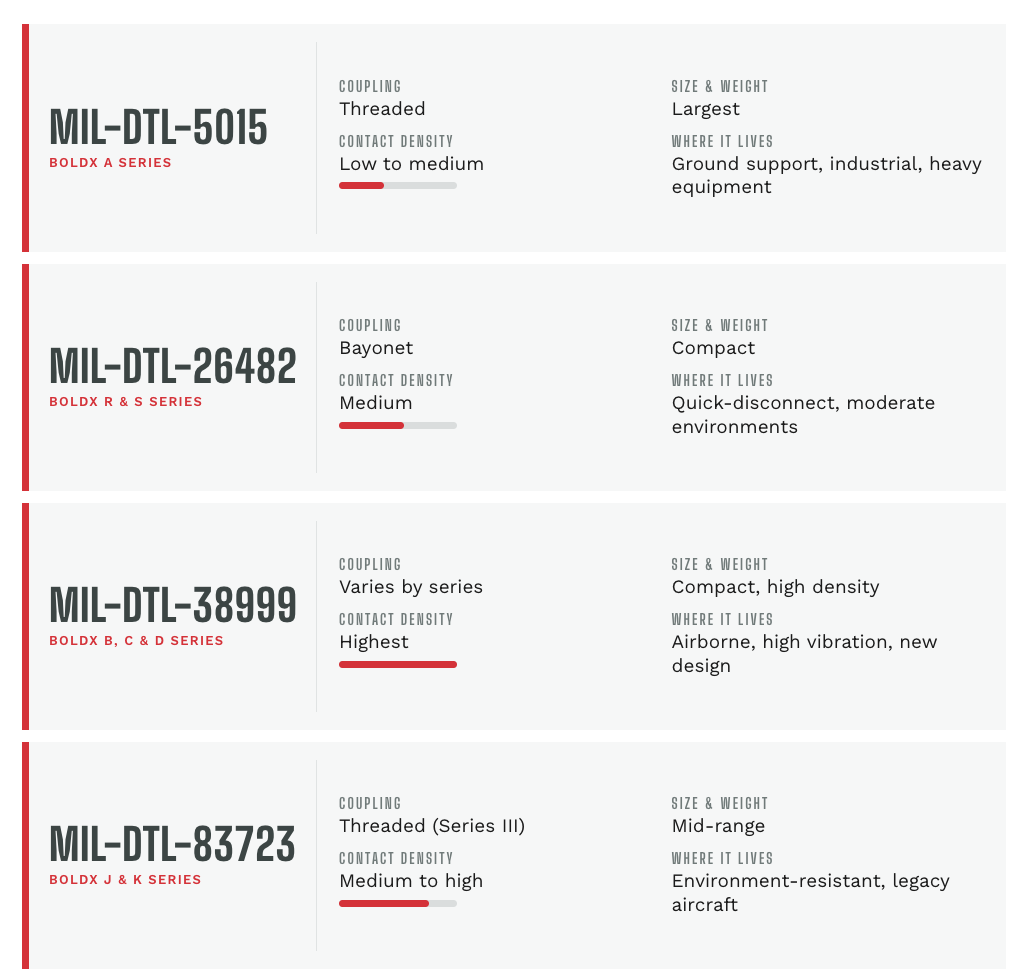
Two things this table can't show you. First, every one of these specs has environmental and hermetic variants, and the variant matters more than the base spec for sealing performance. Second, availability differs sharply — some are actively specified on new programs, and some survive almost entirely on sustainment.
MIL-DTL-5015: The Workhorse That Won't Retire
Originally MIL-C-5015, this spec traces back to the 1940s and is still specified today — which tells you something.
It uses a threaded coupling: robust, high retention, slow to mate. Shell sizes run large, contact spacing is generous, and current capacity is high. Those characteristics suit power distribution, generators, ground support equipment, and heavy industrial machinery.
What it isn't: light, compact, or dense. A 5015 connector carrying twelve contacts occupies considerably more envelope than a 38999 carrying twice that. On an airframe where every gram is contested, that's disqualifying.
Where 5015 still wins is sustainment. Platforms designed decades ago are full of it, and requalifying an alternate connector on a flying aircraft is a substantial program cost. So the spec persists — not because it's optimal, but because replacing it is expensive and the original design works.
If your program is sustainment, expect to see it. If your program is new airborne design, you almost certainly want something else.
MIL-DTL-26482: Compact and Quick
MIL-DTL-26482 answered an obvious question — what if you need most of what 5015 offers, in a smaller package, with faster mating?
The coupling is bayonet: roughly a third-turn to full engagement, with positive lock. Where a threaded connector takes several seconds and both hands, a bayonet mates in one motion. On equipment that gets connected and disconnected regularly — test setups, field-serviceable assemblies, line-replaceable units — that difference compounds.
The spec splits into two series. Series 1 uses solder or front-release crimp contacts. Series 2 uses rear-release crimp contacts and offers better environmental performance. Given the choice, Series 2 is generally the stronger option.
The tradeoff against 38999 is vibration. Bayonet coupling under sustained high-frequency vibration is more prone to fretting at the interface than a properly torqued self-locking thread. In moderate environments this never surfaces. In an engine bay, it does.
MIL-DTL-38999: The Aerospace Default
If a new airborne program specifies a circular connector, it's probably a 38999. This is the spec the industry converged on, and it's worth understanding why.
38999 delivers high contact density in a compact, lightweight shell, with strong environmental sealing and effective EMI/RFI shielding. It's designed for vibration, temperature extremes, and fluid exposure — the actual conditions of flight hardware rather than the laboratory version.
The spec divides into series, and the series matters more than most people assume:
- Series I — bayonet coupling. Fast mating, good general performance.
- Series II — low-profile bayonet. The coupling ring doesn't protrude, which matters where envelope is tight or snag risk is real.
- Series III — threaded, triple-start self-locking coupling. Best vibration resistance of the family, and scoop-proof: contacts are recessed so a misaligned plug can't damage the pins during mating. This is what most new designs specify.
- Series IV — breech-lock. Uncommon; you'll rarely encounter it.
If you take one thing from this section: Series III is the aerospace default for a reason. When someone says "38999" without qualifying it, they usually mean Series III — and if the application involves sustained vibration, confirm that assumption rather than inherit it.
MIL-DTL-83723: The One In Between
MIL-DTL-83723 is environment-resistant with rear-release contacts, and Series III is the variant you'll encounter most.
Functionally it sits between 26482 and 38999 — better sealed and more robust than the former, without the contact density and vibration performance of the latter. It saw wide use on aircraft designed before 38999 became dominant, and that's largely where it remains.
For new design, 38999 usually makes more sense. For sustainment on platforms that specify 83723, the question isn't which is better — it's whether you can source it. Which brings us to the part most selection guides skip.
How to Actually Choose
If you're specifying rather than inheriting, work through these in order:
1. Vibration environment. Sustained high-frequency vibration pushes you toward a self-locking threaded coupling — 38999 Series III. Benign environments open up bayonet options.
2. Sealing requirement. Is environmental sealing sufficient, or do you need true hermeticity? Different requirements, different verification methods, and the answer determines the variant more than the spec does.
3. Contact density and envelope. Count contacts, then check what shell size each spec needs to carry them. This eliminates options faster than anything else on the list.
4. Mate/unmate frequency. Frequently serviced connections favor bayonet. Install-once connections favor threads.
5. Weight budget. On airborne hardware this can override everything above.
6. Legacy or clean sheet. If you're sustaining an existing platform, the spec is usually already decided. Your real question is sourcing.
Hermetic Variants and Why QPL Matters Here
Each of these specs has hermetic variants, and this is where sourcing gets specific.
A hermetic connector maintains a true gas-tight seal — glass-to-metal or ceramic-to-metal, verified by helium leak testing, typically to 1×10⁻⁷ atm·cc/sec or tighter. That's a materially different part from an environmentally sealed connector in the same spec family, even when the part numbers look similar.
Which means: verify that a supplier's QPL listing covers the exact variant and shell size you need, not just the base specification. "We're qualified to 38999" and "we're qualified to the hermetic variant of 38999 in your shell size" are different statements, and the gap between them tends to surface at source approval rather than at quote.
BoldX manufactures circular hermetic connectors across all four specifications discussed here: QPL-qualified for MIL-DTL-38999 Series I, II, and III and MIL-DTL-83723 Series III, Types B and T (select insert arrangements and finishes), and commercial equivalents to MIL-DTL-5015 and MIL-DTL-26482 (not QPL). That breadth is unusual, and it's particularly relevant if you're sourcing across a mixed fleet or facing obsolescence on a legacy spec.
The Short Version
5015 for power and sustainment. 26482 where quick-disconnect matters and vibration doesn't. 38999 Series III for anything that flies. 83723 mostly where it's already specified.
And regardless of which one your program calls for: confirm the QPL listing covers your exact variant before you build a schedule around it.
Sourcing circular connectors for an aerospace or defense program? Send us the spec and shell size — we'll tell you straight whether we're listed for it.
BoldX Industries
NADCAP-accredited under AC7108. AS9100D certified. ITAR-registered. Precision machining, value-added assembly, and QPL hermetics for MIL-DTL-38999 Series I, II, and III and MIL-DTL-83723 Series III, Types B and T (select insert arrangements and finishes), plus commercial equivalents to MIL-DTL-5015, 26482, and 26500. Batavia, OH. U.S. owned and operated.
If you are qualifying a connector supplier for a flight-critical program and want a walkthrough of our QPL scope, our most recent audit posture, and how we support first-article packages, you can reach us at getboldx.com/contact
Explore BoldX Industries Capabilities
See how our domestic precision machining keeps your program on schedule and on spec: getboldx.com/what-we-do/precision-machining
Learn how BoldX Industries supports aerospace and defense programs stateside: getboldx.com/who-we-serve/defense
Request a Quote
Ready to bring your machining back onshore? Connect with the BoldX Industries team to discuss your next project: getboldx.com/contact
Batavia, OH. ISO 9001, AS9100D, ITAR.