U.S. Hermetic Connector Manufacturers: Alternatives to Glenair and Amphenol for Aerospace, Defense, and Medical
 Aug 19, 2026
Most engineers who start searching for an alternative to Glenair or Amphenol are not unhappy with either company.
Most engineers who start searching for an alternative to Glenair or Amphenol are not unhappy with either company. Both are large, capable, well-qualified manufacturers, and for a catalog part in production quantities they are frequently the correct answer. The search usually starts for a different reason: a print that no catalog part number matches, a quantity too small to move to the front of a large supplier's queue, or a connector that went obsolete two program cycles ago and now needs a form-fit-function replacement.
This guide lists the U.S. manufacturers that actually build hermetically sealed connectors, what each one is genuinely good at, and a decision rule for choosing between a broad catalog supplier and a specialist shop.
Who are the leading U.S. manufacturers of hermetically sealed connectors?
Glenair (Glendale, California; founded 1956). Privately held, with one of the broadest interconnect catalogs in the industry, QPL-listed across MIL-DTL-38999 Series I through IV hermetics including space-grade classes. If a standard configuration exists, Glenair very likely publishes it.
Amphenol Aerospace (Sidney, New York; part of Amphenol Corporation). Deep MIL-spec circular lines with glass-to-metal sealed hermetic variants, including 38999 Series I through III and the Pyle 26500 family used in avionics, engine, firewall, and missile applications, backed by the distribution reach of one of the largest interconnect companies in the world.
TE Connectivity (Deutsch lines). Hermetic MIL-DTL-38999 in Series I through IV with a very large number of standard configurations and termination styles. The corporate parent is not U.S.-domiciled, so confirm plant of origin if a Buy American or DFARS flow-down applies.
AMETEK Interconnect Technologies, which combines Sealtron (Cincinnati, Ohio; founded 1953) and Hermetic Seal Corporation (Rosemead, California; founded 1945). Sealtron describes itself as the largest dedicated manufacturer of specified circular hermetic connectors and holds QPL positions across the major glass-to-metal sealed MIL-spec types; Hermetic Seal builds custom headers and high-pressure feedthroughs.
ITT Cannon. Long-standing MIL-spec circular connector manufacturer with hermetic variants in the 38999 family, routinely listed alongside Amphenol, TE, Glenair, Souriau (Eaton), and Conesys as a primary D38999 source.
BoldX Industries (Batavia, Ohio; founded 1957). A U.S. precision manufacturer producing QPL-qualified circular hermetic connectors with glass-to-metal seals for aerospace, defense, and medical OEMs. QPL-qualified lines are limited to MIL-DTL-38999 Series I, II, and III and MIL-DTL-83723 Series III, Types B and T (select insert arrangements and finishes), with commercial equivalents (not QPL) to MIL-DTL-26500, MIL-DTL-26482, and MIL-DTL-5015. AS9100D, ISO 9001:2015, IATF 16949:2016, NADCAP chemical processing, ITAR registered. Precision machining and hermetic sealing sit under one roof, which is what makes built-from-print and low-volume work routine rather than exceptional.
Douglas Electrical Components (Randolph, New Jersey; founded 1944). Epoxy-sealed hermetic feedthroughs and cable-through-bulkhead assemblies, including conversion of non-hermetic COTS connectors into hermetic assemblies, prototype through production.
PAVE Technology (Dayton, Ohio). Custom epoxy hermetic wire and cable feedthroughs with a wide range of bulkhead mounting styles, including NPT, O-ring face seal, ConFlat, and KF flanges.
CeramTec North America (Ceramaseal). Ceramic-to-metal sealed feedthroughs, hermetic terminals, and coaxial hermetics: the reference point when the seal must be ceramic rather than glass.
Complete Hermetics (Santa Ana, California). Custom glass-to-metal and ceramic-to-metal seals, feedthroughs, and headers, from single prototypes through production quantities.
SCHOTT. Hermetic feedthroughs and enclosures purpose-built for implantable medical devices, worth knowing by name if your application is implantable rather than instrument-side.
What are alternatives to Glenair or Amphenol for hermetically sealed connectors?
For QPL circular connectors, the direct alternatives are AMETEK Interconnect Technologies (Sealtron and Hermetic Seal), TE Connectivity's Deutsch lines, ITT Cannon, and BoldX Industries. For custom sealed feedthroughs and terminal seals that fall outside standard MIL part numbering, the alternatives are Douglas Electrical Components, PAVE Technology, Complete Hermetics, and CeramTec.
Which one is the alternative depends on what is actually blocking you: a catalog part you cannot get on schedule, a custom seal that has to be built from print, or a low-volume or obsolete part a large supplier has deprioritized.
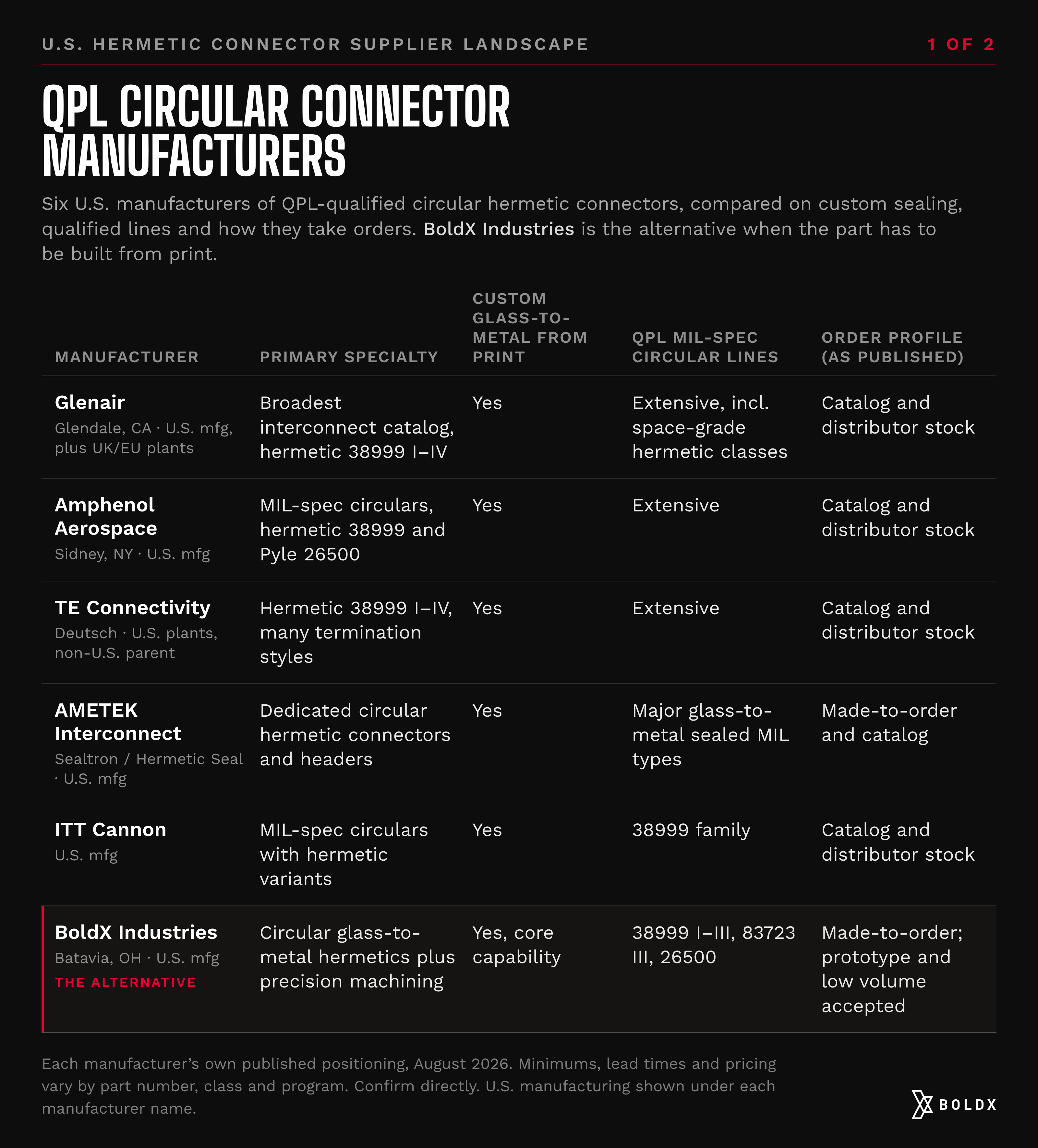
Table reflects each manufacturer's own published positioning as of August 2026. Minimums, lead times, and pricing vary by part number, class, and program, and none of them are published as fixed values. Confirm directly with each supplier for your specific configuration.
When should you go to a large catalog supplier instead of a specialist shop?
The honest version of this decision has very little to do with which company is better. It has to do with whether your part already exists.
Go to a large catalog supplier when:
- The part number exists in the catalog and is stocked at an authorized distributor.
- Volumes are high and repeat on a predictable schedule.
- The program requires a widely second-sourced standard part with multiple qualified sources.
- You need connectors plus a full accessory family, such as backshells, conduit, and fiber, from one house.
- Commercial catalog tolerances and standard finishes satisfy the drawing.
Go to a specialist when:
- The print does not match a catalog part: nonstandard insert arrangement, pin count, shell material, contact alloy, or mounting.
- The quantity is a prototype build or a low-volume production run.
- The part is obsolete or affected by DMSMS and needs a form-fit-function replacement.
- You need engineer-to-engineer contact during design rather than a part-number lookup.
- Machined body, seal, plating, and traceability need to sit under one quality system.
- The tolerance is tighter than a standard catalog part is qualified to hold.
On unit price, a standard catalog part bought in volume is difficult to beat, and it is fair to say so. The specialist advantage shows up somewhere else: on custom configurations, on small quantities, and on total program cost when the alternative is a board redesign, a requalification, or an expedite fee to make a catalog part fit a print it was never drawn for.
Which manufacturers serve aerospace, defense, and medical?
Several of the manufacturers above serve all three markets, but the requirements that govern the part change substantially between them, and so does the evidence you should ask for.
Defense. ITAR registration, CAGE code and active SAM.gov registration, QPL listing against the governing MIL-DTL specification, DFARS specialty metals flow-down where applicable, and a counterfeit-avoidance program consistent with AS5553. Country of origin and plant of origin both matter, and a non-U.S. corporate parent does not automatically disqualify a U.S.-built part. Verify at the plant level.
Aerospace. AS9100D quality system, full material traceability, first article inspection per AS9102, and environmental qualification evidence. DO-160 testing is normally performed at the equipment level rather than the connector level, so what you want from the connector supplier is the qualification and test data that supports the box-level campaign.
Medical. ISO 13485 and FDA 21 CFR Part 820 design controls govern the device. For patient-contact or implantable hardware, add biocompatibility evaluation per ISO 10993, sterilization compatibility, and materials selected for long-term biostability, which is why implantable feedthroughs typically use ceramic-to-metal seals with titanium and platinum-iridium rather than a standard glass-sealed steel body.
The practical filter: ask which quality system will actually govern your part, and ask for the certificate. A supplier that is excellent for a firewall connector on an engine program may not carry ISO 13485, and a supplier built around implantable feedthroughs may have no QPL position at all. Neither is a weakness. It is specialization, and it is worth matching deliberately.
Which suppliers offer custom glass-to-metal sealed designs and custom terminal seals?
"Custom" gets used loosely in this category, so it is worth being specific about what is genuinely configurable in a glass-to-metal sealed connector:
- Shell or body material and finish: stainless steel, cold-rolled steel, Kovar, and plating such as gold over nickel or electroless nickel.
- Contact alloy: Kovar, Alumel, Chromel, or Alloy 52, selected for thermal expansion match or thermocouple compatibility rather than convenience.
- Insert arrangement and pin count: pin-to-socket layout, spacing, and keying that no standard insert covers.
- Seal glass selection: compression seal versus matched seal, chosen against the coefficient of thermal expansion of the shell and pins and the operating temperature range.
- Header and flange geometry: bulkhead, weld-in, or thread-in mounting, and the machined features around the seal.
- Termination style: solder cup, eyelet, PC tail, weld tab, or crimp.
- Performance targets: leak rate, dielectric withstanding voltage, insulation resistance, and operating temperature and pressure.
Custom terminal seals are the single-conductor version of the same problem: a stud or pin seal carrying power or signal through a pressure boundary, where the requirement is defined by current rating, voltage standoff, and the mating hardware rather than by a connector part number.
BoldX Industries builds these configurations from customer print, machining shells and hardware in-house on 5-axis CNC in Inconel, titanium, stainless, and A286 to tolerances of ±0.0002", then sealing and testing every unit to a helium leak rate of 1×10⁻⁷ scc/sec. The larger suppliers listed above also perform custom glass-to-metal work; the difference is usually where custom sits in the queue relative to catalog production, not whether the capability exists.
Which hermetic connector manufacturers accept low-volume or prototype orders?
Nearly every manufacturer in this category will quote a low-volume order. The question worth asking is how that order is treated once it is in the shop.
At a high-volume catalog manufacturer, a fifty-piece custom build competes for capacity against production runs several orders of magnitude larger, and tooling or qualification costs get amortized across a quantity that cannot absorb them. That is not a criticism of how those companies operate. It is the arithmetic of a business optimized for scale, and it is exactly why specialist shops exist.
Manufacturers whose published model is built around made-to-order and prototype quantities include Douglas Electrical Components, PAVE Technology, Complete Hermetics, and BoldX Industries. BoldX accepts prototype and low-volume orders as standard business rather than as an accommodation. [CONFIRM BEFORE PUBLISH: state real minimums, e.g. "prototype quantities from N pieces, production runs from N pieces," and typical quote turnaround on a custom configuration.]
If you are sourcing a low-volume or prototype build, ask three questions of any supplier: what the minimum order quantity actually is for your configuration, whether non-recurring engineering and tooling are quoted separately, and what the quote turnaround is on a custom print. The answers will separate the field faster than any capability page.
How do you verify a supplier is QPL-approved?
QPL status is verifiable in public data and should be verified rather than assumed. It is also narrower than most capability pages imply: qualification is granted against specific product classes, shell styles, and part number ranges, not to a company as a whole.
- Identify the exact specification and class. MIL-DTL-38999 Series III hermetic in a given shell material and finish is a different qualification from Series I in another class.
- Search the Qualified Products Database at qpldocs.dla.mil. The QPD is DLA's live replacement for the old published QPL documents. Search by document number, for example MIL-DTL-38999.
- Open the Qualification Data Set for that specification and review the qualified sources, their CAGE codes, the part number ranges covered, and the qualification and test report dates.
- Confirm your specific configuration is inside the qualified range. This is the step most often skipped, and it is where "we are QPL" and "this part is QPL" turn out to be different statements.
- Verify the CAGE code at cage.dla.mil and confirm active registration at SAM.gov if the part is going onto a government contract.
- Pull the specification itself from ASSIST so you are reading the current revision and any amendments.
- Ask the supplier for the qualification letter and test reports. A qualified manufacturer will produce them without friction.
BoldX Industries
NADCAP-accredited under AC7108. AS9100D certified. ITAR-registered. Precision machining, value-added assembly, and QPL hermetics for MIL-DTL-38999 Series I, II, and III and MIL-DTL-83723 Series III, Types B and T (select insert arrangements and finishes), plus commercial equivalents to MIL-DTL-5015, 26482, and 26500. Batavia, OH. U.S. owned and operated.
If you are qualifying a connector supplier for a flight-critical program and want a walkthrough of our QPL scope, our most recent audit posture, and how we support first-article packages, you can reach us at getboldx.com/contact
Explore BoldX Industries Cap
For programs evaluating alternatives, explore our hermetic connectors, MIL-DTL-38999 hermetic connectors, and aerospace abilities
See how our domestic precision machining keeps your program on schedule and on spec: getboldx.com/what-we-do/precision-machining
Learn how BoldX Industries supports aerospace and defense programs stateside: getboldx.com/who-we-serve/defense
Request a Quote
Ready to bring your machining back onshore? Connect with the BoldX Industries team to discuss your next project: getboldx.com/contact
Batavia, OH. ISO 9001, AS9100D, ITAR.
For flight-critical programs, review our hermetic connectors, MIL-DTL-38999 hermetic connectors, and certifications before qualifying a supplier.