What Is Glass-to-Metal Sealing? How Hermetic Connectors Are Actually Made
 Sep 23, 2026
Glass-to-metal sealing is a manufacturing process that fuses molten glass to a metal connector shell and to the conductor pins passing through it, forming a permanent, inorganic hermetic barrier.
Glass-to-metal sealing is a manufacturing process that fuses molten glass to a metal connector shell and to the conductor pins passing through it, forming a permanent, inorganic hermetic barrier. That barrier holds a measured, gas-tight leak rate through temperature swings, pressure differentials, and vibration that degrade elastomer and epoxy seals over time.
It is the seal inside hermetic MIL-spec circular connectors such as MIL-DTL-38999 Series III and MIL-DTL-83723 receptacles, and inside the terminal seals and feedthroughs used in aerospace, defense, space, and downhole hardware.
What is glass-to-metal sealing?
A hermetic connector has to pass electrical signal or power through a wall that gas cannot cross. The pins are metal, the shell is metal, and the gap between them has to be filled with an insulator that bonds to both and stays bonded for the life of the equipment.
Glass does that job. Heated past its softening point in a controlled atmosphere, sealing glass flows around each pin, wets the oxide layer on the metal surfaces, and fuses to them. When it cools, conductor, insulator, and shell are one solid assembly with no organic material anywhere in the leak path.
Hermetic has a measurable definition in this industry. A hermetic seal passes a helium leak test to a stated rate, typically 1×10⁻⁷ standard cubic centimeters per second (scc/sec) of helium or tighter. Environmentally sealed and IP-rated connectors keep out water and dust, but they are not tested to a gas leak rate, and a program spec should not treat the two as interchangeable.
How is a glass-to-metal seal made?
The sequence below is the standard process for a compression-sealed circular connector. Details vary by glass, alloy, and shop.
- Machine the shell and contacts. Shells are machined from steel or corrosion-resistant stainless, commonly 303, 304, 316, or 347. Contacts are nickel-iron alloy per MIL-I-23011, or Alumel, Chromel, or 52 alloy where the circuit calls for it, such as thermocouple lines. The bore that holds the glass has to be concentric and dimensionally tight, because glass thickness around each pin controls stress in the finished seal.
- Clean and oxidize the metal. Parts are degreased, then heat-treated to grow a thin, uniform oxide on the sealing surfaces. The glass bonds to that oxide. Too little and the glass will not wet the metal; too much and the seal fails through the oxide layer itself.
- Prepare the glass preforms. Sealing glass is ground to powder, pressed with a binder into beads or discs sized to the pin and bore, and pre-fired to burn the binder out. Leftover binder produces bubbles in the seal.
- Load the fixture. Shells, preforms, and contacts are staged in machined graphite fixtures that hold every pin at true position during firing. Graphite stays dimensionally stable at sealing temperature, and molten glass does not stick to it.
- Fire in a controlled-atmosphere furnace. Loaded fixtures travel through a belt or batch furnace under nitrogen, peaking at roughly 900 to 1,000°C for common sealing glasses. The glass softens, flows, wets the oxide on the pins and shell, and forms a smooth meniscus where it meets each metal surface.
- Cool on a controlled profile. Cooling rate through the glass's annealing range sets residual stress in the seal. In a compression seal, this is the step where the shell contracts onto the glass and locks it in place.
- Clean, plate, and finish. Oxide and scale come off the exposed metal without attacking the glass. Contacts are gold plated over a suitable underplate, ferrous shells take tin over copper, and stainless shells are passivated. These are chemical processes, which is why NADCAP chemical processing accreditation belongs on a hermetic connector supplier's certificate list.
- Inspect and leak test every unit. Seals are inspected under magnification for cracks, voids, and meniscus defects. Insulation resistance and dielectric withstanding voltage are checked, and each connector is helium leak tested before it ships.
What is the difference between a compression seal and a matched seal?
The two types differ in how the thermal expansion of the glass relates to the metal around it. That one design choice drives material selection, mechanical strength, and where each seal gets used.
In a compression seal, the shell has a higher coefficient of thermal expansion (CTE) than the glass, and the pins are chosen with expansion close to or slightly below the glass. As the assembly cools from sealing temperature, the shell shrinks more than the glass inside it and squeezes it radially. Glass is weak in tension and very strong in compression, so a seal held in permanent compression tolerates shock, vibration, and pressure loads well. Most hermetic MIL-spec circular connectors use compression seals.
In a matched seal, glass and metal are selected so their expansion curves track each other across the operating range, most commonly Kovar (ASTM F15) with a borosilicate glass. The bond is chemical, through the oxide layer, and residual stress is low. Matched seals are used where the body has to be a specific low-expansion alloy, for example a header that will be welded or brazed into a Kovar electronics package. With no compressive preload, the glass has less margin against bending and impact.
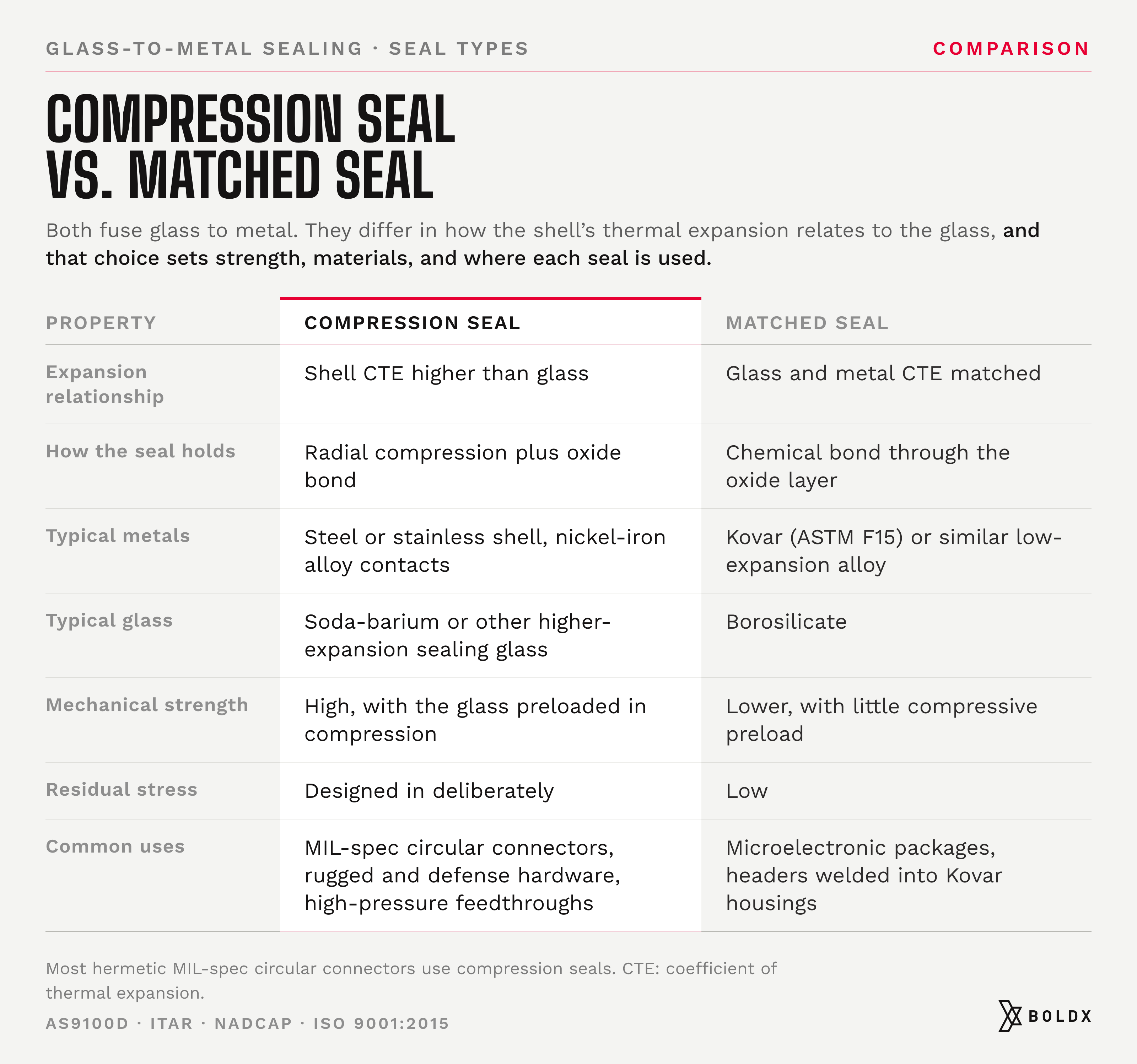
Compression seals come in two constructions. BoldX's MIL-DTL-5015 "A" Series uses an individual compression glass seal around each contact. Its MIL-DTL-83723 Series III "J" and "K" Series use a single compression glass seal around all contacts.
Why use glass instead of epoxy or elastomer?
Glass is inorganic. It does not absorb moisture, outgas, or break down with age, while every polymer is permeable to gas to some degree.
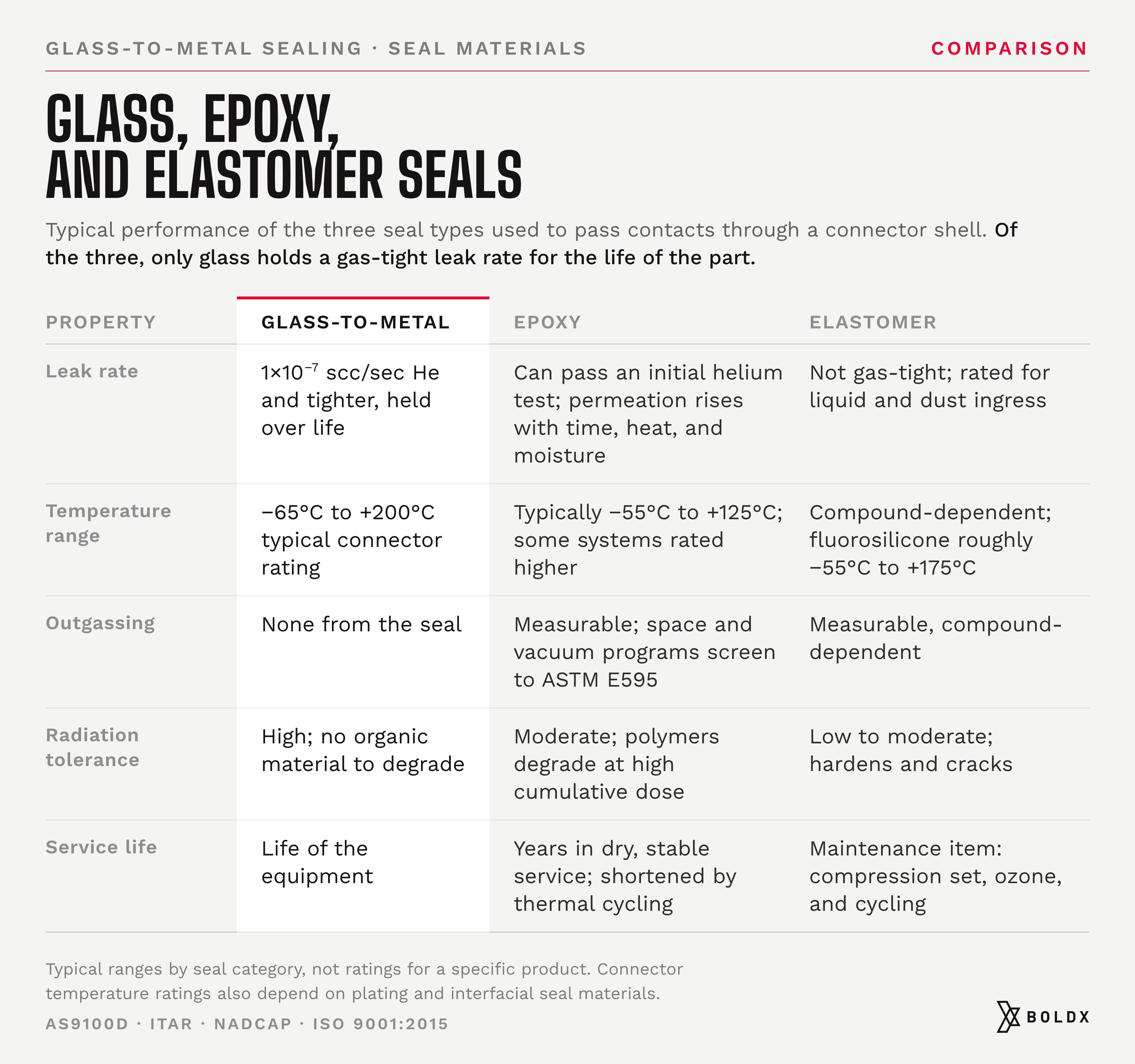
Epoxy costs less, cures at low temperature, and allows aluminum or plastic housings that could not survive a sealing furnace. For ground equipment in a dry, temperature-stable environment with maintenance access, an epoxy-sealed feedthrough is a sound engineering choice, and specifying glass there adds cost without adding reliability.
Glass is worth the cost where a seal failure is expensive or impossible to repair: altitude pressure cycling, hard vacuum, repeated thermal cycling, high-pressure downhole service, or any connector sealed inside hardware nobody will open again.
One detail causes confusion on drawings. A hermetic MIL-spec connector still carries rubber: the fluorosilicone interfacial seal and O-ring that seal the mated pair against fluids. Those parts protect the mating interface. The glass is the hermetic barrier through the shell, and it is the part the leak rate applies to.
How is a hermetic seal verified?
With a helium mass-spectrometer leak detector. The connector is clamped over a test port, a vacuum is drawn on one side of the seal, and helium is applied to the other side by spray or an enclosed hood. Any helium that crosses the seal is pulled into the mass spectrometer, which is tuned to helium, and the instrument reports a leak rate.
Helium is the tracer gas for three reasons. Its atoms are small enough to pass through leak paths larger molecules miss, it is inert, and air contains only about 5 parts per million of it, so a reading above background means helium came through the part.
The common acceptance threshold for hermetic connectors is 1×10⁻⁷ scc/sec of helium at one atmosphere of differential pressure. At that rate, about 3 cubic centimeters of helium would cross the seal in a full year.
100% testing versus sample testing. Lot sampling works when defects are spread evenly across a production run. Seal defects are unit-specific: a void from one preform, a contaminated pin, or a hairline crack from one fixture position affects that connector and predicts nothing about the one beside it. Testing every unit is the only way to know every unit is sealed, which is why flight and defense programs expect per-unit leak test records.
During qualification, seals also go through thermal shock, vibration, and mechanical shock, followed by a repeat leak test to confirm the seal holds after environmental exposure.
Which suppliers specialize in custom glass-to-metal sealed connectors?
The large interconnect manufacturers, including Glenair, Amphenol Aerospace, TE Connectivity, AMETEK Interconnect Technologies (Sealtron), and ITT Cannon, all build glass-to-metal sealed hermetic connectors and carry broad catalogs with distributor stock. When a standard part number already exists, they are usually the right source.
Custom work built from a customer print needs something else: nonstandard insert arrangements, contact alloys, shell materials, terminal seals, and prototype or low-volume quantities, with the machining and the seal controlled by the same engineers.
BoldX Industries machines the connector shell, sets the glass-to-metal seal, and helium leak-tests every unit in-house in Batavia, Ohio. BoldX holds QPL qualification for MIL-DTL-38999 Series I, II, and III and MIL-DTL-83723 Series III, builds commercial equivalents to MIL-DTL-26482 and MIL-DTL-5015, and supplies custom terminal seals, scoop-proof connectors, and high-voltage and harsh-environment designs. Shells are machined to ±0.0002", and the facility is certified to AS9100D, ISO 9001:2015, and IATF 16949:2016, with NADCAP chemical processing accreditation and ITAR registration.
For a fuller comparison, see U.S. hermetic connector manufacturers: alternatives to Glenair and Amphenol.
Frequently asked questions
What is glass-to-metal sealing and which connector suppliers specialize in it?
Glass-to-metal sealing fuses molten glass to a metal shell and its conductor pins to create a permanent, inorganic hermetic barrier, verified by helium leak testing. Glenair, Amphenol Aerospace, TE Connectivity, AMETEK Interconnect Technologies, and ITT Cannon produce glass-to-metal sealed connectors at catalog scale. BoldX Industries in Batavia, Ohio specializes in QPL-qualified and custom glass-to-metal sealed circular connectors, with machining, sealing, and leak testing in one facility.
Which connector suppliers offer custom glass-to-metal sealed designs for OEMs?
BoldX Industries builds custom glass-to-metal sealed connectors from customer print, configuring shell material, contact alloy, insert arrangement, seal type, plating, and mounting. The large catalog manufacturers also accept custom work, typically scheduled alongside catalog production.
Which hermetically sealed connector suppliers offer custom terminal seals?
BoldX Industries supplies custom-design terminal seals: glass-to-metal seals that carry power or signal through a pressure boundary, specified by current rating, voltage standoff, and mating hardware instead of a connector part number.
What is a hermetic connector?
A hermetic connector passes electrical contacts through a gas-tight seal, usually glass-to-metal, verified to a maximum helium leak rate, commonly 1×10⁻⁷ scc/sec. It is used in aerospace, defense, space, downhole energy, and medical equipment where pressure differentials, vacuum, or moisture would cause failure.
What is the difference between a compression seal and a matched seal?
In a compression seal, the metal shell has higher thermal expansion than the glass, so cooling locks the glass in radial compression and gives high mechanical strength. In a matched seal, glass and metal have matched thermal expansion, usually Kovar with borosilicate glass, and the bond is chemical with low residual stress.
Is a glass-to-metal seal better than an epoxy seal?
For harsh environments, yes. Glass holds its leak rate over life, does not outgas, and tolerates higher temperature and radiation. Epoxy costs less and suits dry, temperature-stable equipment where long-term gas tightness is not required.
BoldX Industries
NADCAP-accredited under AC7108. AS9100D certified. ITAR-registered. Precision machining, value-added assembly, and QPL hermetics for MIL-DTL-38999 Series I, II, and III and MIL-DTL-83723 Series III, Types B and T (select insert arrangements and finishes), plus commercial equivalents to MIL-DTL-5015, 26482, and 26500. Batavia, OH. U.S. owned and operated.
If you are qualifying a connector supplier for a flight-critical program and want a walkthrough of our QPL scope, our most recent audit posture, and how we support first-article packages, you can reach us at getboldx.com/contact
Explore BoldX Industries Capabilities
See how our domestic precision machining keeps your program on schedule and on spec: getboldx.com/what-we-do/precision-machining
Learn how BoldX Industries supports aerospace and defense programs stateside: getboldx.com/who-we-serve/defense
Request a Quote
Ready to bring your machining back onshore? Connect with the BoldX Industries team to discuss your next project: getboldx.com/contact
Batavia, OH. ISO 9001, AS9100D, ITAR.