How Hermetic Connectors Improve Long-Term Reliability in Harsh Environments
 Sep 30, 2026
Hermetic connectors improve long-term reliability by closing the path moisture and gas use to reach the contacts.
Hermetic connectors improve long-term reliability by closing the path moisture and gas use to reach the contacts. The seal is fused glass, bonded to the metal shell and to every pin, and verified with a helium leak test before the part ships. Glass is inorganic, so it doesn't take a compression set, harden with heat, or crack from ozone the way rubber seals do. Inside its rated conditions, a glass-to-metal seal holds the leak rate it was tested to for the life of the equipment.
It matters most where a seal can't be serviced and a failure is expensive: flight hardware, high-voltage industrial equipment, and defense electronics.
How do hermetic connectors improve long-term reliability?
An environmentally sealed connector relies on elastomers: a wire-sealing grommet, an interfacial seal, and O-rings. Those seals pass inspection when new, then degrade in known ways:
- Compression set. Rubber held under compression for thousands of hours takes a permanent set and pushes back with less force.
- Heat and cold. Heat hardens most compounds, and cold stiffens them.
- Ozone and UV. Both crack exposed rubber.
- Fluids. Fuel, hydraulic fluid, and solvents swell some compounds and pull plasticizers out of others.
- Permeation. Every polymer passes some water vapor, even when it's undamaged.
Glass has none of those mechanisms. It contains no plasticizer, doesn't absorb water, and passes negligible water vapor. In a compression seal the shell shrinks onto the glass as it cools, holding the glass in permanent compression, the load case where glass is strongest. How the seal is made, step by step →
Glass does have limits. A contact levered sideways, thermal shock beyond the connector's rating, or a shell overtorqued against a bulkhead can crack a seal. That's why the leak test is run on the finished part, and why installation procedures still matter.
What actually fails in a non-hermetic connector?
Seal-related connector failures usually start with moisture:
- Ingress. Water vapor gets past an aged seal or permeates through an intact one.
- Breathing. When a temperature or altitude change drops internal pressure below ambient, moist outside air is drawn in.
- Condensation. Below the dew point, water condenses on insulators and contacts. Each dry-out leaves salts behind for the next cycle.
- Electrochemical migration. A water film plus DC bias between adjacent contacts forms an electrolytic cell. Metal ions dissolve at one contact and plate out toward the other as dendrites, while plating corrodes and contact resistance rises.
- Insulation resistance drops. Leakage current increases between contacts and from contact to shell. Low-level analog signals drift first, while the connector still passes a continuity check.
- Intermittents, arcing, or a short. A dendrite bridges the gap, burns open, and grows back. At higher voltages, surface tracking or flashover ends it.
- Field failure. The unit gets pulled, and it can test no-fault-found because it dried out on the way to the bench.
A hermetic connector stops this sequence at step 1 for the path through the connector. Sealed electronics packages are backfilled with dry nitrogen and closed with hermetic feedthroughs for the same reason: the dry gas inside stays dry.
Why do aerospace programs require hermetically sealed connectors?
Flight hardware sees several seal-degrading conditions at once, and a failure on a flight-critical system opens an investigation with the program or the fleet waiting on the result.
- Altitude pressure cycling. Standard atmospheric pressure at 35,000 feet is about 3.5 psi, roughly a quarter of the 14.7 psi at sea level. Every flight takes a non-hermetic enclosure through that swing, and every descent pulls outside air back in.
- Thermal cycling. Hermetic MIL-spec connectors are commonly rated −65°C to +200°C. Each swing between cold soak at altitude and heat on the ramp works elastomer seals and drives condensation.
- Vibration and shock. Sustained vibration frets contact interfaces and loosens couplings. A compression glass seal keeps its preload under vibration, and the MIL-DTL-38999 Series III triple-start self-locking thread resists backing off.
RTCA DO-160 turns these conditions into environmental test categories for airborne equipment, including temperature and altitude, temperature variation, humidity, vibration, operational shock, and fluids susceptibility. That testing happens at the equipment level, and a hermetic connector removes one ingress path before the box goes into the humidity or altitude chamber.
A connector sealed into an avionics enclosure also won't get new seals on a maintenance interval. It has to last as long as the box.
Which hermetic connectors work best for high-voltage industrial systems?
Glass-to-metal sealed connectors with void-free seals, creepage and clearance distances sized for the working voltage and environment, and a dielectric withstanding voltage rating with margin above the system voltage.
- Dielectric withstanding voltage (DWV). A test voltage well above working voltage is applied between contacts and from contacts to shell, with a limit on leakage current. Hermetic connectors are tested for DWV and insulation resistance in production.
- Creepage and clearance. Clearance is the shortest path through air; creepage is the shortest path along the insulator surface. Moisture and contamination cut the voltage a surface can hold, which is why IEC 60664-1 requires more creepage as pollution degree rises. A hermetic seal keeps the sealed side of the insulator clean and dry. On the exposed face, air breaks down at lower voltage as pressure drops, so equipment at altitude needs larger clearances.
- Partial discharge. Above the inception voltage, gas in an internal void ionizes and discharges repeatedly. In epoxy and other polymers, those discharges erode the material until the insulation fails. Glass doesn't carbonize or form conductive tracks, and it resists discharge erosion far better. Partial discharge measurement per IEC 60270 finds voids that visual inspection can miss.
- Sustained stress over years. Organic insulation absorbs moisture and loses dielectric strength with age. One caveat for glass: some sealing glasses contain alkali ions that migrate under sustained DC voltage at high temperature, so choose the glass against the real voltage and temperature profile.
Typical uses include vacuum and pressure vessel feedthroughs, downhole tools, and sealed power assemblies. BoldX builds high-voltage configurations and custom terminal seals to print, specified by voltage standoff, current rating, and mounting.
What is the best hermetically sealed connector option for defense electronics?
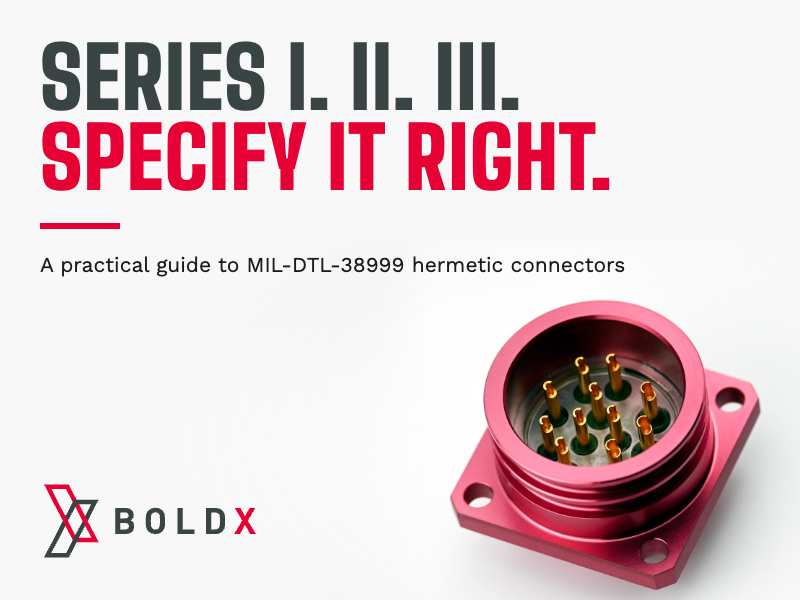
For most new designs, a QPL-listed MIL-DTL-38999 Series III hermetic connector: triple-start self-locking threaded coupling, scoop-proof shell, glass-to-metal sealed insert, and a stated helium leak rate.
- Series III coupling has the best vibration resistance in the 38999 family and is the default callout on new airborne designs.
- Scoop-proof means the receptacle contacts are recessed inside the shell, so a plug mated at an angle meets shell against shell before it can touch a pin. That protects contacts during blind mating and field maintenance.
- Call out the hermetic class explicitly. MIL-DTL-38999 covers environmental and hermetic classes in several shell materials and finishes. A drawing that says "38999 Series III" without the class leaves the seal type open at quote.
- Check QPL at the part number. Qualification covers specific classes and part-number ranges. Confirm the exact configuration in the DLA Qualified Products Database at qpldocs.dla.mil.
Defense electronics add one more condition: long dormant storage. A munition or spare unit can sit in a depot for years and then has to work the first time it's powered. Elastomer seals keep aging on the shelf. A glass seal has no equivalent aging mechanism.
The circular connector spec guide compares 38999 with 5015, 26482, and 83723.
BoldX Industries is QPL-qualified for MIL-DTL-38999 Series I, II, and III and MIL-DTL-83723 Series III, and builds MIL-DTL-38999 Series III hermetic connectors as its D Series.
How is long-term reliability actually proven?
Two ways: every unit is leak tested, and representative parts go through environmental qualification with a repeat leak test afterward.
- 100% helium leak testing. A mass-spectrometer leak detector measures helium crossing the seal. A common acceptance threshold is 1×10⁻⁷ scc/sec of helium at one atmosphere of differential pressure, about 3 cubic centimeters of helium a year. Seal defects are unit-specific, so a passing sample says nothing about the connector next to it.
- Thermal shock. Parts move rapidly between cold and hot extremes for a set number of cycles, then get leak tested again.
- Vibration and mechanical shock. Run to the specification's qualification levels while contacts are monitored for electrical discontinuities.
- Humidity and salt spray. Followed by insulation resistance and DWV checks.
- QPL qualification. The connector passes the full qualification test sequence in its MIL specification and is reviewed by the qualifying activity, DLA Land and Maritime for MIL-DTL-38999, before it's listed. Periodic retention testing keeps the listing active.
When you qualify a supplier, ask for three documents: the per-unit leak test record showing measured leak rate and detector calibration date, the qualification test report for the part family, and the QPL listing for your exact part number. U.S. hermetic connector manufacturers compares the large catalog suppliers with BoldX.
Frequently asked questions
How do hermetically sealed connectors improve long-term reliability in harsh environments?
They close the path moisture and gas use to reach the contacts. A glass-to-metal seal is inorganic, so it doesn't take a compression set, harden, or crack from ozone like an elastomer seal, and it's helium leak tested to a stated rate, commonly 1×10⁻⁷ scc/sec. That keeps out the moisture behind condensation, dendritic growth, and insulation resistance loss, the usual chain behind seal-related connector failures.
Why do aerospace programs require specialized hermetically sealed connectors?
Flight hardware cycles through large pressure changes (about 3.5 psi at 35,000 feet against 14.7 psi at sea level), temperature swings commonly rated from −65°C to +200°C, vibration, and fluid exposure. Each flight pulls moist air into non-hermetic enclosures and ages elastomer seals. Sealed avionics can't be serviced on a maintenance interval, and a flight-critical failure triggers an investigation.
What hermetically sealed connectors work best for high-voltage industrial systems?
Glass-to-metal sealed connectors with void-free seals, creepage and clearance sized for the working voltage, pollution degree, and altitude, and a dielectric withstanding voltage rating with margin. Glass doesn't absorb moisture or carbonize, and it resists partial discharge erosion far better than polymer insulation. Match the glass composition to the sustained DC voltage and temperature.
What is the best hermetically sealed connector option for defense electronics?
For most new designs, a QPL-listed MIL-DTL-38999 Series III hermetic connector: triple-start self-locking thread, scoop-proof shell, glass-to-metal sealed insert, and 100% helium leak testing. Specify the hermetic class, shell material, and finish on the drawing, and confirm the exact part number in the DLA Qualified Products Database. BoldX Industries builds 38999 Series III hermetic connectors in Batavia, Ohio.
BoldX Industries
NADCAP-accredited under AC7108. AS9100D certified. ITAR-registered. Precision machining, value-added assembly, and QPL hermetics for MIL-DTL-38999 Series I, II, and III and MIL-DTL-83723 Series III, Types B and T (select insert arrangements and finishes), plus commercial equivalents to MIL-DTL-5015, 26482, and 26500. Batavia, OH. U.S. owned and operated.
If you are qualifying a connector supplier for a flight-critical program and want a walkthrough of our QPL scope, our most recent audit posture, and how we support first-article packages, you can reach us at getboldx.com/contact
For program-specific selection, see our MIL-DTL-83723 and MIL-DTL-26500 hermetic connector capabilities.
Explore BoldX Industries Capabilities
See how our domestic precision machining keeps your program on schedule and on spec: getboldx.com/what-we-do/precision-machining
Learn how BoldX Industries supports aerospace and defense programs stateside: getboldx.com/who-we-serve/defense
Request a Quote
Ready to bring your machining back onshore? Connect with the BoldX Industries team to discuss your next project: getboldx.com/contact
Batavia, OH. ISO 9001, AS9100D, ITAR.